

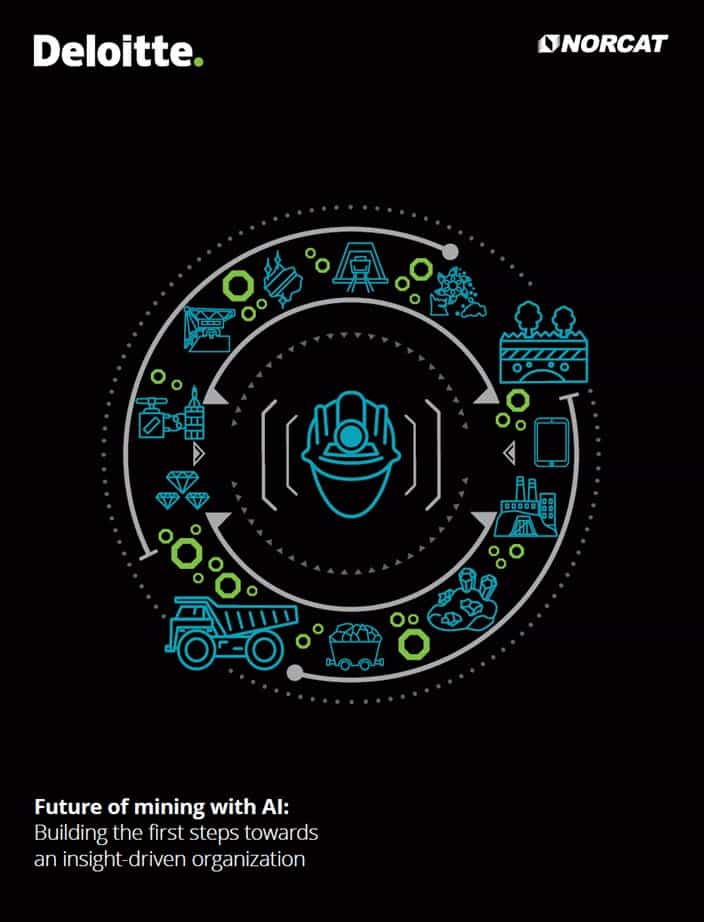
In 2018, WipWare founder Tom Palangio contributed his industry experience to Future of Mining with AI: Building the First Steps Towards an Insight-Driven Organization, a report developed by Deloitte and NORCAT examining the opportunities and challenges associated with artificial intelligence in mining.
The report explored how mining operations could introduce emerging technologies, overcome barriers to adoption, and make more effective use of operational data.
Drawing on decades of experience in explosives engineering and fragmentation measurement, Palangio discussed the mining industry’s traditional reluctance to adopt unfamiliar technologies. New solutions must not only demonstrate technical capability but also address operational risks, implementation costs, and the practical needs of the people using them.
INDUSTRY CULTURE – Tom Palangio
Mining was traditionally perceived as a risky undertaking with uncertain grades, investment volatility and variable metal prices so every opportunity to reduce risk and stay with the proven methods of operation was encouraged. This risk aversion stifled innovation opportunities and many major operations avoided taking the lead in proving empirical performance of new technologies because the up‑front costs and the potential failure or risks involved with bleeding edge innovations was considered unwise. WipWare’s approach was to focus on improving the daily experience of frontline workers—including shifting from entirely trial and error practices of the past, where employees attempting to predict the crusher gap often increased equipment downtime. Relying on neural networks, WipWare provides real time material sizing data throughout the mining process that enables automated process control, which improve workers’ abilities to anticipate disruptions in their operations and cut costs through less downtime and extended equipment life.” (Page 7)
His contribution highlighted an important distinction: collecting more data is not necessarily the same as making better decisions. Measurement becomes valuable when information reaches the people and systems capable of acting on it.
The report also discussed how automated material sizing and other technologies could support more informed process control by helping operations recognize changing conditions and respond accordingly.
Read the Deloitte and NORCAT Report
Read Future of Mining with AI through Deloitte’s research collection.
For a practical example of how material measurements can inform decisions across mining operations, explore From Blast to Mill: Using Fragmentation Data to Improve Mining Performance.
 WipWare