

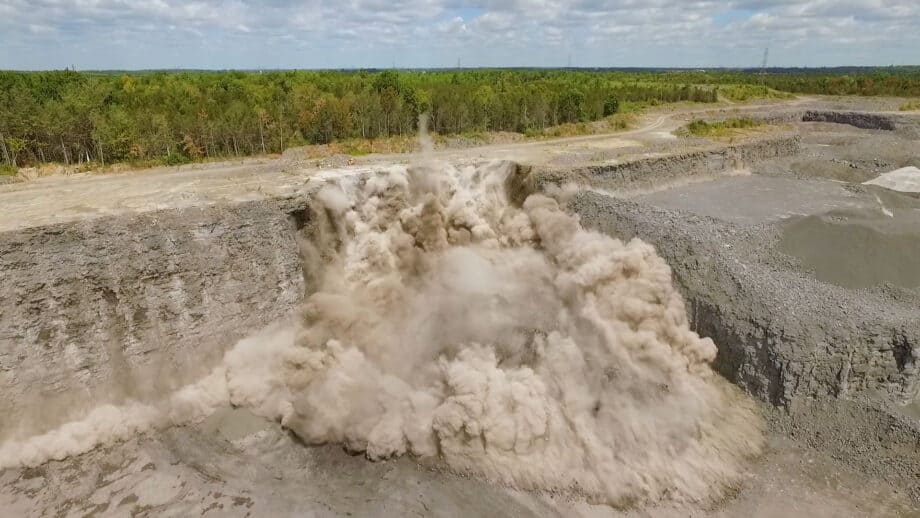
Explore the fundamentals of rock blasting and fragmentation, including explosive energy, burden, spacing, drilling accuracy, and how particle size measurements support blast optimization.
Table of contents
- 1. How Explosive Blasting Breaks Rock
- 2. Rock Properties and Geological Influences
- 3. Understanding Blast Geometry
- 4. Explosive Energy Distribution and Confinement
- 5. How Excessive Burden Affects Fragmentation
- 6. Drilling Accuracy and Blast Execution
- 7. What Determines Successful Blast Fragmentation?
- 8. Measuring and Evaluating Blast Fragmentation
- 9. From Fragmentation Measurement to Blast Optimization
- Conclusion
- References
Rock blasting is an essential part of mining, quarrying, and construction. By using explosives to break large volumes of rock into manageable fragments, operations can excavate, transport, crush, and process material more efficiently.
However, successful blasting involves more than simply breaking rock. The resulting fragmentation must also meet the requirements of the equipment and processes that follow. Material that is too coarse may cause problems during loading or crushing, while excessive fines can introduce other handling and processing challenges.
The size and distribution of rock fragments depend on several interconnected factors, including rock properties, explosive characteristics, blast geometry, drilling accuracy, and initiation timing.
Understanding these relationships, and measuring the results, provides the foundation for improving blasting performance.
Jump to:
1. How Explosive Blasting Breaks Rock
•
2. Rock Properties and Geological Influences
•
3. Understanding Blast Geometry
•
4. Explosive Energy Distribution and Confinement
•
5. How Excessive Burden Affects Fragmentation
•
6. Drilling Accuracy and Blast Execution
•
7. What Determines Successful Blast Fragmentation?
•
8. Measuring and Evaluating Blast Fragmentation
•
9. From Fragmentation Measurement to Blast Optimization
•
•
•
1. How Explosive Blasting Breaks Rock
When an explosive charge detonates inside a blasthole, it releases energy that generates intense pressure and stress waves in the surrounding rock.
The interaction between these forces, expanding explosive gases, and the physical properties of the rock causes fractures to develop and fragments to separate.
Rock breakage is generally understood as a combination of several mechanisms.
Shock Waves and Initial Fracturing
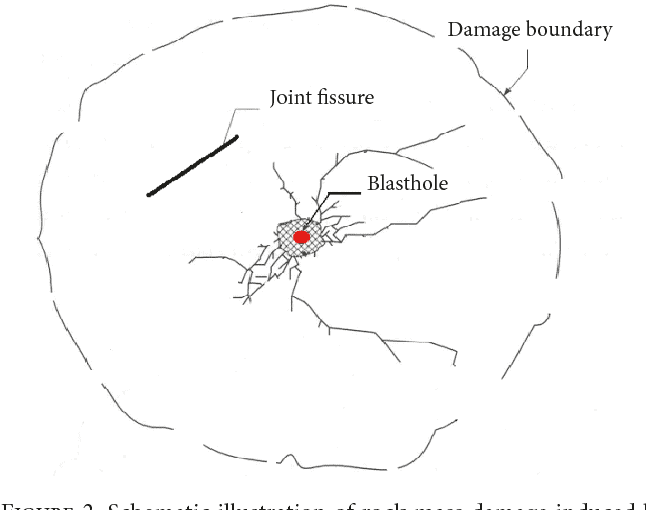
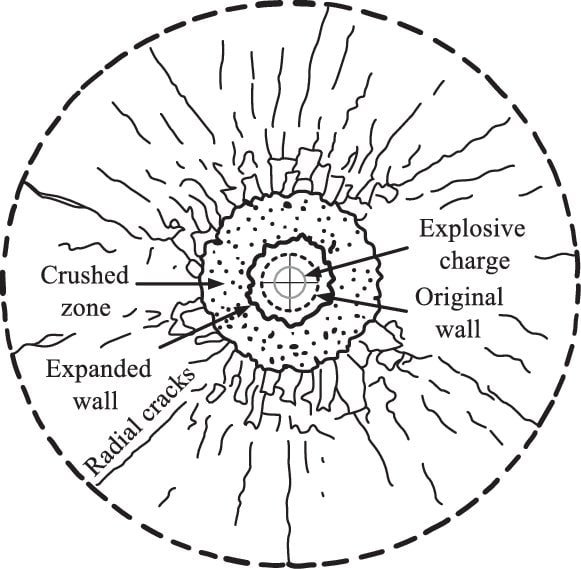
Detonation generates a high-pressure shock wave that travels outward from the blasthole.
Immediately surrounding the charge, pressure can exceed the rock’s compressive strength, creating a relatively small crushed zone. Beyond this zone, the shock wave weakens into a stress wave that travels through the surrounding rock mass.
These stresses can initiate new fractures, extend existing cracks, and weaken the rock structure.
The extent of fracturing depends on the characteristics of the explosive, the strength and structure of the rock, and how the energy travels through the material.
Tensile Fracturing and Free Faces
Although rock can withstand considerable compressive stress, it is generally much weaker under tension.
When a compressive stress wave reaches a free face, such as the exposed wall of a quarry bench, part of the wave reflects as a tensile wave.
If the resulting tensile stress exceeds the rock’s tensile strength, fractures can develop.
This mechanism can contribute to spalling, where layers of rock separate near a free surface.
Early research by Hino (1956) described how reflected stress waves could contribute to successive layers of fracture formation. This helped establish an important part of the theoretical understanding of explosive rock breakage.
However, tensile-wave reflection is only one mechanism involved in blasting. Existing joints, bedding planes, expanding gases, and rock movement also play important roles in determining the final fragmentation.
Expanding Gases and Rock Movement
Following detonation, high-pressure explosive gases can enter fractures and force them farther apart.
As these fractures expand, portions of the rock mass separate and begin moving toward available free faces.
Additional breakage may occur as rock fragments bend, separate, collide, and interact with surrounding material.
The combined action of stress waves, gas pressure, and rock movement determines how effectively the rock mass breaks apart.
The important distinction is that blasting must accomplish two things: fracture the rock and provide sufficient movement for the fragments to separate. A blast can generate extensive cracking yet still produce poor results if the rock is too confined to move effectively.
Jump to:
1. How Explosive Blasting Breaks Rock
•
2. Rock Properties and Geological Influences
•
3. Understanding Blast Geometry
•
4. Explosive Energy Distribution and Confinement
•
5. How Excessive Burden Affects Fragmentation
•
6. Drilling Accuracy and Blast Execution
•
7. What Determines Successful Blast Fragmentation?
•
8. Measuring and Evaluating Blast Fragmentation
•
9. From Fragmentation Measurement to Blast Optimization
•
•
•
2. Rock Properties and Geological Influences
The characteristics of the rock mass strongly influence blasting performance.
Two blasts using similar drilling patterns and explosive loading can produce very different fragmentation when the geological conditions change.
Rock Strength and Density
Rock strength influences the stresses required to initiate and extend fractures.
Stronger rock may resist breakage more effectively, while differences in density and elastic properties affect how stress waves propagate through the material.
These properties must be considered alongside the explosive energy and geometry of the blast.
Joints, Faults, and Bedding Planes
Most rock masses contain natural discontinuities, including joints, faults, fractures, and bedding planes.
These features influence how the rock breaks because they form existing boundaries or weaknesses within the material.
In some cases, discontinuities assist fragmentation by providing surfaces along which the rock can separate.
In others, their spacing, orientation, or condition can contribute to large blocks, uneven fragmentation, or undesirable rock movement.
For example, widely spaced joints may allow large sections of rock to remain intact even when the surrounding material fractures more extensively.
Geological Variability
Geological conditions are rarely uniform across an entire blast.
Changes in rock strength, weathering, joint spacing, and structural orientation can produce different fragmentation results within the same drilling pattern.
This variability is important when evaluating blasting performance. An area containing large fragments may indicate a design or drilling problem, but it may also reflect differences in the rock itself.
Understanding the rock mass before blasting helps establish realistic expectations and provides valuable context when reviewing the results.
Characterizing Rock Structure with WipJoint
To better understand geological conditions before blasting, WipFrag includes WipJoint, a tool for characterizing rock structure from photographs of exposed rock faces. WipJoint measures apparent joint orientation, spacing, and persistence, along with estimated Rock Quality Designation (RQD) and apparent in-situ block size.
These measurements help identify variations in rock structure across a bench or excavation, providing valuable context when evaluating blast performance. By comparing pre-blast rock characteristics with post-blast fragmentation, operations can better distinguish the influence of geological conditions from blast design and execution.
Jump to:
1. How Explosive Blasting Breaks Rock
•
2. Rock Properties and Geological Influences
•
3. Understanding Blast Geometry
•
4. Explosive Energy Distribution and Confinement
•
5. How Excessive Burden Affects Fragmentation
•
6. Drilling Accuracy and Blast Execution
•
7. What Determines Successful Blast Fragmentation?
•
8. Measuring and Evaluating Blast Fragmentation
•
9. From Fragmentation Measurement to Blast Optimization
•
•
•
3. Understanding Blast Geometry
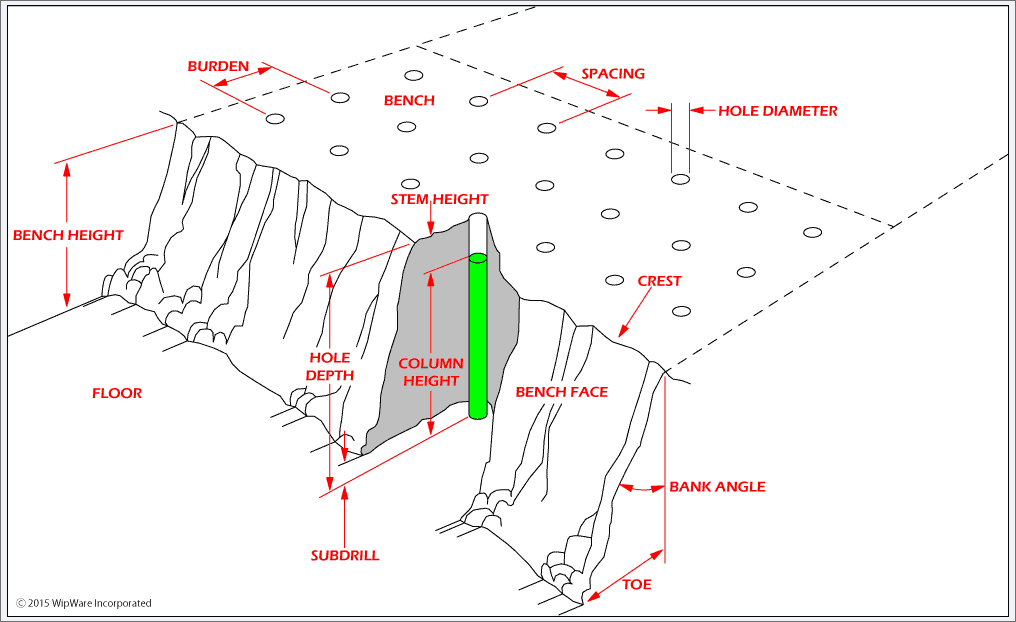
Blast geometry describes how blastholes are positioned relative to one another, the rock mass, and available free faces.
Several parameters work together to determine how effectively explosive energy is distributed and how the rock can fracture and move.
Burden and Spacing
Burden is the distance between a blasthole and the nearest effective free face, measured in the intended direction of rock movement.
For the first row of a bench blast, this generally refers to the distance from the blasthole to the exposed bench face.
For subsequent rows, burden is associated with the distance to the preceding row or effective free face as the blast progresses.
Spacing is the distance between adjacent blastholes within a row.
Together, burden and spacing influence the volume of rock assigned to each blasthole and how the effects of neighbouring charges interact.
If burden or spacing is excessive, some sections of rock may not fracture or move as intended. If they are insufficient, undesirable energy concentrations or excessive displacement may occur.
The objective is to establish a suitable relationship between the rock volume, explosive energy, available relief, and desired fragmentation.
Bench Height
Bench height is the vertical distance between the upper and lower working levels of a bench.
It influences blast geometry, the length of the blastholes, and the movement of the broken rock.
One commonly used geometric consideration is the burden stiffness ratio, expressed as bench height divided by burden.
This relationship helps describe the proportions of a bench relative to the rock mass that must move toward the free face.
Relatively low stiffness ratios can indicate more difficult conditions for effective rock movement and fragmentation, while higher ratios may offer more favourable relief under suitable conditions.
However, the ratio is not a universal predictor of fragmentation quality. Geological conditions, drilling accuracy, explosive distribution, and initiation timing remain important.
Blasthole Diameter
Blasthole diameter influences the amount of explosive that can be placed within a hole and how that energy is distributed through the surrounding rock.
Larger holes generally accommodate greater explosive quantities per unit length, but this does not automatically produce better fragmentation.
Hole diameter must be considered alongside burden, spacing, bench height, rock properties, and the requirements of the operation.
Subdrilling and Toe Breakage
The toe is the rock near the bottom of a bench that must be broken to achieve the intended excavation level.
In some blast designs, blastholes extend below the planned excavation floor. This additional depth is known as subdrilling.
Its purpose is to help provide adequate breakage near the toe, where rock movement may be particularly restricted.
Insufficient toe breakage can leave hard, unbroken rock that interferes with excavation and subsequent bench preparation.
However, the appropriate amount of subdrilling depends on geological conditions and the overall blast design. Excessive subdrilling can also create unwanted damage below the intended excavation level.
Blast geometry must therefore be evaluated as a connected system rather than a collection of independent measurements.
Jump to:
1. How Explosive Blasting Breaks Rock
•
2. Rock Properties and Geological Influences
•
3. Understanding Blast Geometry
•
4. Explosive Energy Distribution and Confinement
•
5. How Excessive Burden Affects Fragmentation
•
6. Drilling Accuracy and Blast Execution
•
7. What Determines Successful Blast Fragmentation?
•
8. Measuring and Evaluating Blast Fragmentation
•
9. From Fragmentation Measurement to Blast Optimization
•
•
•
4. Explosive Energy Distribution and Confinement
The amount of explosive energy used in a blast is important, but its distribution within the rock mass is equally significant.
More explosive energy does not necessarily result in better fragmentation. The objective is to apply energy effectively to the material being broken.
Explosive Characteristics
Different explosives produce different pressure profiles, detonation characteristics, and energy outputs.
The interaction between these properties and the surrounding rock influences fracture development and rock movement.
Selecting suitable explosives requires consideration of rock properties, blasthole conditions, desired fragmentation, and the overall blast design.
A related design measure is powder factor, which expresses the quantity of explosive relative to the amount of rock being blasted, commonly by mass or volume.
Powder factor is useful for comparing explosive consumption, but it does not describe how effectively that energy is distributed.
Two blasts with similar powder factors may produce different fragmentation because of differences in geometry, geology, loading distribution, and initiation.
Charge Distribution
The explosive charge may not be distributed uniformly along the entire length of a blasthole.
Different portions of the rock mass can present different breakage requirements, particularly where confinement or geological conditions vary.
The distribution of explosive energy along the hole can therefore influence fragmentation at different elevations within the bench.
An important consideration is the lower portion of the charge, often called the bottom charge, which contributes to breaking rock near the toe.
Poor energy distribution near the bottom of the bench can contribute to inadequate toe breakage, while inappropriate loading elsewhere can produce unwanted fragmentation or rock movement.
The objective is to distribute energy according to the requirements of the rock mass and the blast design.
Stemming and Confinement
Stemming is the inert material placed in the upper portion of a blasthole above the explosive charge.
Its purpose is to help confine the explosive gases long enough for their energy to contribute to rock breakage and movement.
The effectiveness of stemming depends on its properties, placement, and the surrounding blast conditions.
Insufficient confinement can allow energy to escape prematurely, potentially reducing the energy available for fragmentation and contributing to undesirable blast effects.
Stemming is therefore an important part of the overall energy distribution and confinement strategy, rather than simply material used to fill the top of a hole.
Initiation Timing and Burden Relief
The sequence and timing of detonation influence how neighbouring charges interact and how rock movement develops during the blast.
As a row of blastholes detonates, the surrounding rock requires time to respond and begin moving. That movement can provide additional relief for subsequent rows.
If the intended relief has not developed sufficiently, later detonations may encounter more confinement than anticipated.
Research by Onederra and Esen (2003) examined this relationship using the concept of minimum response time: the interval between detonation and the beginning of meaningful burden movement.
The concept illustrates why initiation timing cannot be considered independently of burden, explosive properties, and rock response.
Effective blast sequencing supports the intended progression of rock breakage and movement, helping achieve more consistent fragmentation.
Jump to:
1. How Explosive Blasting Breaks Rock
•
2. Rock Properties and Geological Influences
•
3. Understanding Blast Geometry
•
4. Explosive Energy Distribution and Confinement
•
5. How Excessive Burden Affects Fragmentation
•
6. Drilling Accuracy and Blast Execution
•
7. What Determines Successful Blast Fragmentation?
•
8. Measuring and Evaluating Blast Fragmentation
•
9. From Fragmentation Measurement to Blast Optimization
•
•
•
5. How Excessive Burden Affects Fragmentation
Burden is one of the most influential geometric factors in bench blasting because it affects both the resistance to rock breakage and the movement required to separate the fragments.
Excessive burden occurs when the rock mass assigned to a blasthole presents too much resistance for the available explosive energy and blast conditions to produce the intended result.
This may reflect an unsuitable original design or differences between the planned and actual blasthole geometry.
Incomplete Fragmentation and Oversize
When burden is excessive, the rock may not fracture and separate as intended.
Large fragments, slabs, or partially broken sections can remain, producing a coarser particle size distribution than expected.
These oversized fragments may require secondary breaking or create problems during excavation, hauling, and crushing.
Restricted Rock Movement
Blasting requires sufficient space for broken rock to move and separate.
Excessive burden can restrict this movement, creating tightly packed muckpiles or preventing sections of rock from obtaining the intended relief.
Restricted movement can also affect later rows in the blast by limiting the free faces available to them.
Ground Vibration and Other Blast Effects
When rock movement is restricted, some explosive energy may be transmitted into the surrounding ground rather than contributing effectively to fragmentation and displacement.
Under certain conditions, this can contribute to increased ground vibration.
However, vibration, flyrock, and air overpressure are influenced by multiple interacting variables. Excessive burden should not be treated as the sole explanation for any of these effects.
Downstream Handling and Processing
Poor fragmentation can create costs beyond the blast itself.
Oversize material may reduce excavation efficiency, interrupt crusher feeding, or require additional handling before entering the processing circuit.
Even where the material can be processed, inconsistent feed size may create variations in equipment performance.
The importance of burden therefore extends beyond the drilling and blasting operation.
What Happens When Burden Is Too Small?
Insufficient burden creates a different set of challenges.
Where too little rock separates a blasthole from the free face, excessive or uncontrolled movement may occur, depending on the other blast conditions.
This can contribute to flyrock, overbreak, or undesirable fragmentation.
The objective is not to minimize burden, but to establish a suitable relationship between burden, explosive energy, rock properties, and the intended blast outcome.
Research: Burden and Fragment Size
Prasad, Choudhary, and Mishra (2017) examined the influence of blast design parameters on fragmentation at a surface mining operation.
Their research considered factors including burden, stemming, and powder factor, using measured fragment sizes to evaluate the resulting blast performance.
The observations illustrate how changes in blast geometry and explosive loading can be associated with changes in fragmentation.
The original WipWare discussion highlighted results suggesting that larger burden distances were associated with coarser fragmentation under the conditions examined.
However, this relationship should not be treated as a universal rule.
The effect of burden depends on the surrounding blast design and geological conditions. A change that produces coarser fragmentation at one operation may produce a different result elsewhere.
For this reason, measured fragmentation and actual blast records provide a more useful basis for evaluating burden than relying on generalized design ratios alone.
Jump to:
1. How Explosive Blasting Breaks Rock
•
2. Rock Properties and Geological Influences
•
3. Understanding Blast Geometry
•
4. Explosive Energy Distribution and Confinement
•
5. How Excessive Burden Affects Fragmentation
•
6. Drilling Accuracy and Blast Execution
•
7. What Determines Successful Blast Fragmentation?
•
8. Measuring and Evaluating Blast Fragmentation
•
9. From Fragmentation Measurement to Blast Optimization
•
•
•
6. Drilling Accuracy and Blast Execution
Even a well-designed blast can produce inconsistent fragmentation if the blastholes are not drilled according to the intended pattern.
Drilling deviation describes differences between the planned and actual position, direction, or trajectory of a blasthole.
These differences can alter burden, spacing, and explosive energy distribution throughout the rock mass.
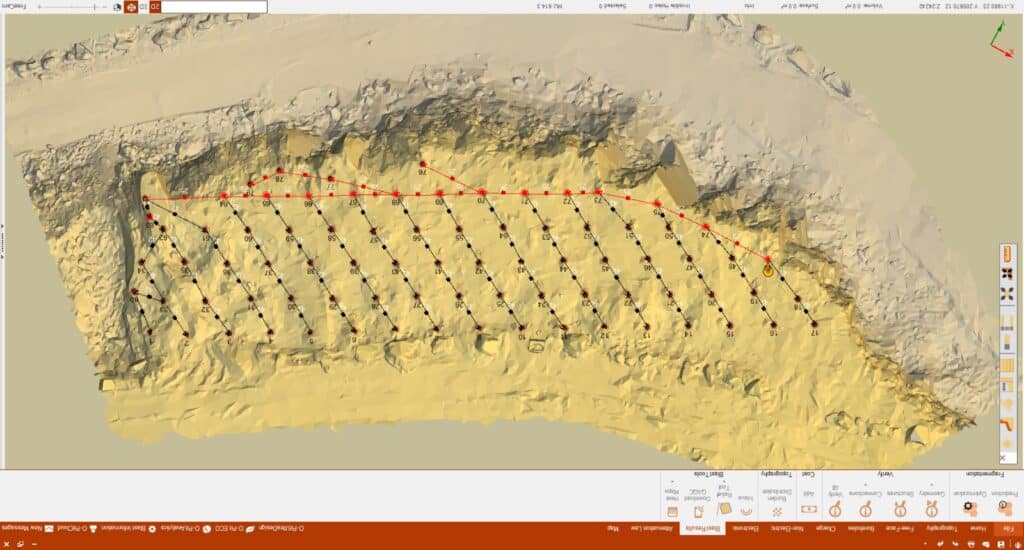
How Drilling Deviation Changes Blast Geometry
A blasthole that deviates away from a free face can create greater burden at depth than the original design intended.
Conversely, a hole that deviates toward the free face may reduce the effective burden.
Similar changes can occur in spacing between neighbouring blastholes.
This means a drilling pattern that appears correct at the surface may contain significant geometric variations farther down the holes.
Some areas may consequently receive less effective energy relative to the rock being broken, while others may experience undesirable concentrations.
The resulting fragmentation can become inconsistent across the blast.
Common Sources of Drilling Inaccuracy
Several factors can contribute to differences between designed and actual blasthole geometry.
Equipment positioning, drill alignment, drilling conditions, geological structure, and equipment performance can all influence the final hole trajectory.
Operator practices and the accuracy of the initial drilling layout also matter.
The consequences can be particularly significant in deeper blastholes, where small changes in direction may result in larger positional differences near the toe.
Evaluating Drilling Accuracy
Drilling accuracy can be assessed through several complementary measurements.
Collar position identifies differences between the planned and actual starting location of a blasthole.
Hole angle and trajectory describe the direction and path followed by the hole. A hole may begin in the correct position but gradually deviate as drilling progresses.
Toe position identifies the location of the hole’s endpoint relative to its intended position. This is particularly useful for evaluating burden and spacing near the bottom of the bench.
Hole length provides information about drilling depth, but a difference in length does not necessarily indicate lateral deviation. A hole may reach the correct depth while following an incorrect trajectory.
Where appropriate, borehole surveys and drilling records help establish the actual geometry of the blast.
Comparing this information with measured fragmentation can reveal relationships between drilling execution and blast performance.
Jump to:
1. How Explosive Blasting Breaks Rock
•
2. Rock Properties and Geological Influences
•
3. Understanding Blast Geometry
•
4. Explosive Energy Distribution and Confinement
•
5. How Excessive Burden Affects Fragmentation
•
6. Drilling Accuracy and Blast Execution
•
7. What Determines Successful Blast Fragmentation?
•
8. Measuring and Evaluating Blast Fragmentation
•
9. From Fragmentation Measurement to Blast Optimization
•
•
•
7. What Determines Successful Blast Fragmentation?
The purpose of blast optimization is not simply to produce smaller fragments.
The desired particle size distribution depends on how the material will be excavated, transported, crushed, and processed.
Oversize Material
Oversize fragments can create difficulties during loading and hauling and may exceed the acceptable feed size of downstream equipment.
Depending on the operation, oversize may require additional handling, secondary breaking, or adjustments to the material handling process.
Excessive Fines
Very fine fragmentation is not always desirable.
Although smaller particles can reduce some downstream comminution requirements, excessive fines may contribute to dust, material handling difficulties, or undesirable feed characteristics.
The impact depends on the type of material and processing equipment involved.
Fragmentation Consistency
Two blasts may produce similar average fragment sizes but have very different particle size distributions.
One may contain a relatively consistent range of fragments, while another contains a mixture of excessive fines and large boulders.
Both could report similar values for an individual size metric, yet perform differently during loading and processing.
For this reason, blast assessment should consider the overall particle size distribution and the portions of that distribution that matter to the operation.
The importance of fragmentation extends beyond the blast itself. Particle size distribution can influence loading, haulage, crushing, grinding, and the consistency of downstream operations. Understanding these relationships helps establish meaningful fragmentation targets and connect blasting performance with broader operational objectives.
Explore From Blast to Mill: Using Fragmentation Data to Improve Mining Performance to learn how particle measurements can support decisions throughout the mining and processing cycle.
Jump to:
1. How Explosive Blasting Breaks Rock
•
2. Rock Properties and Geological Influences
•
3. Understanding Blast Geometry
•
4. Explosive Energy Distribution and Confinement
•
5. How Excessive Burden Affects Fragmentation
•
6. Drilling Accuracy and Blast Execution
•
7. What Determines Successful Blast Fragmentation?
•
8. Measuring and Evaluating Blast Fragmentation
•
9. From Fragmentation Measurement to Blast Optimization
•
•
•
8. Measuring and Evaluating Blast Fragmentation
Without measurement, evaluating blast performance relies heavily on visual observation and operator experience.
These observations remain valuable, but quantitative fragmentation measurements allow more consistent comparisons between blasts.
Understanding Particle Size Distribution
Particle size distribution (PSD) describes the relative proportions of different particle sizes within a material sample.
PSD is commonly presented as a cumulative percent-passing curve, showing the percentage of material smaller than each particle size.
One frequently used measurement is P80, the particle size at which 80% of the material passes.
P80 can help evaluate fragmentation against a target or compare results between blasts, but it cannot describe the complete distribution on its own.
Other measurements, including P50, P95, and the percentages of material within particular size ranges, may also be important.
For example, an operation concerned about primary crusher blockages may place particular emphasis on the oversize portion of the distribution, while another operation may focus on controlling the amount of material within a specified feed range.
Fragmentation Measurement with WipFrag
WipFrag measures fragmentation from photographs of exposed rock, converting visible particle boundaries into quantitative particle size distribution data.
Images can be collected at ground level, underground, from laboratory samples, or using unmanned aerial vehicles (UAVs).
WipFrag allows users to generate PSD curves, evaluate particle size ranges, compare results against specification envelopes, and combine multiple image analyses into a larger sampling program.
With appropriate UAV imagery, fragmentation can also be evaluated spatially across a blast area, helping identify differences between relatively coarse and fine regions.
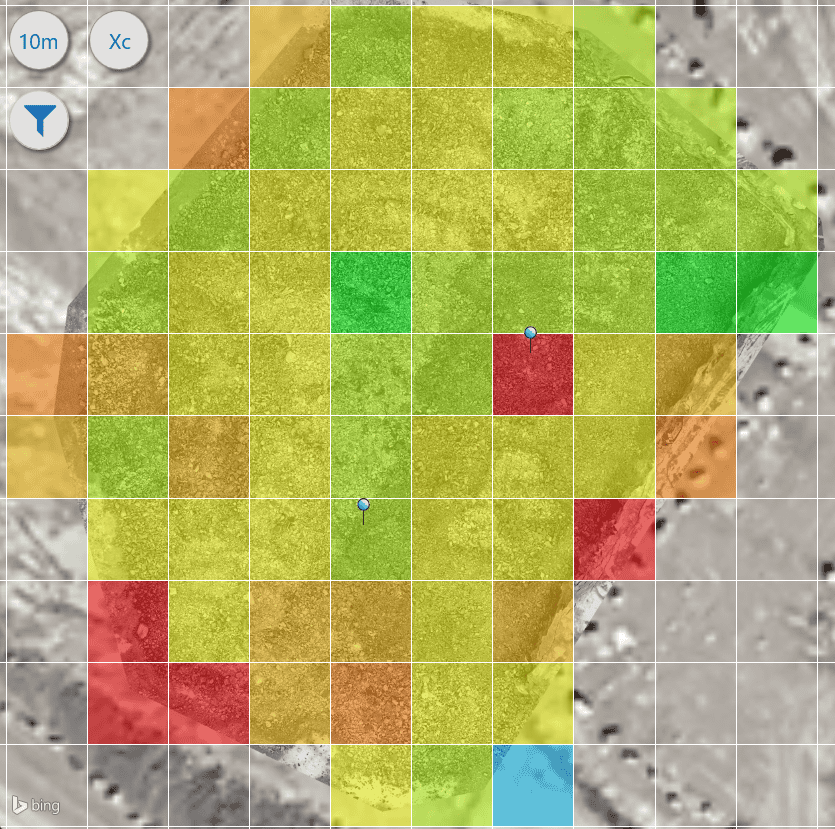
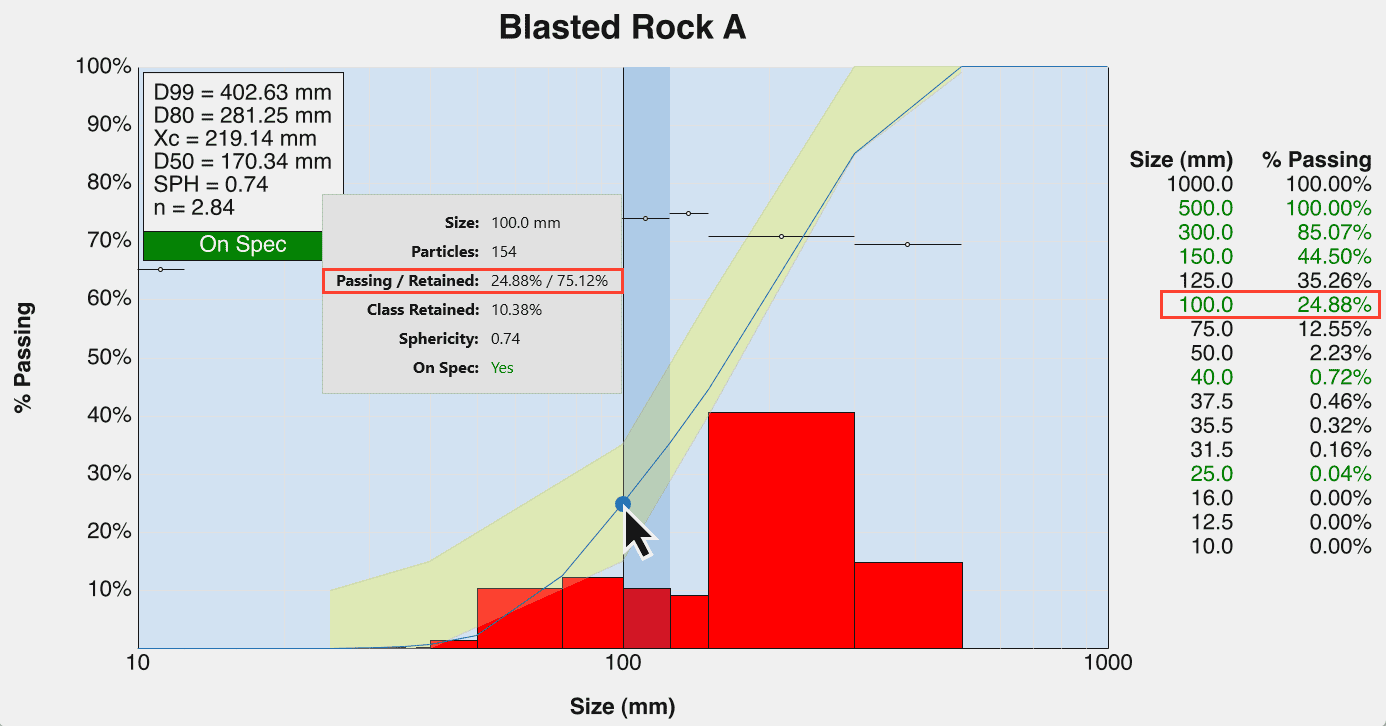
These measurements make it easier to compare the observed fragmentation with operational targets and previous blast results.
However, photographic analysis has important limitations.
WipFrag measures material visible in the images. Buried particles and fines obscured beneath larger fragments cannot be measured directly, and the smallest distinguishable particles depend on image quality and resolution.
A representative sampling program is therefore essential, particularly when evaluating large or variable muckpiles.
For further guidance, see the WipFrag Image Capture and Sampling Guide and WipFrag Results Interpretation Guide.
Can Fragmentation Analysis Identify Blast Design Problems?
Fragmentation measurements can help identify unexpected results and areas that warrant further investigation.
For example, consistently coarse fragmentation may suggest that the burden, spacing, drilling accuracy, geological conditions, or explosive distribution should be reviewed.
Similarly, a spatial fragmentation map may reveal variations across a muckpile that were not apparent from an overall PSD curve.
However, fragmentation measurements describe the result, not necessarily its cause.
Oversize material alone does not prove excessive burden, and changes in PSD cannot independently establish that drilling deviation or initiation timing caused the result.
A more complete evaluation requires comparing fragmentation measurements with the corresponding blast design, drilling records, explosive loading information, and geological conditions.
Jump to:
1. How Explosive Blasting Breaks Rock
•
2. Rock Properties and Geological Influences
•
3. Understanding Blast Geometry
•
4. Explosive Energy Distribution and Confinement
•
5. How Excessive Burden Affects Fragmentation
•
6. Drilling Accuracy and Blast Execution
•
7. What Determines Successful Blast Fragmentation?
•
8. Measuring and Evaluating Blast Fragmentation
•
9. From Fragmentation Measurement to Blast Optimization
•
•
•
9. From Fragmentation Measurement to Blast Optimization
Improving blasting performance requires a consistent relationship between the intended result, the actual fragmentation, and the conditions that produced it.
A practical approach begins with defining the fragmentation requirements of downstream operations.
These requirements establish the particle sizes and distribution characteristics that matter most to the site.
After each blast, representative fragmentation measurements can be collected and compared with these targets.
Where results differ from expectations, engineers can review the corresponding design and execution records to identify possible contributing factors.
For example, if one area of a blast repeatedly produces larger fragments than surrounding areas, the operation can compare that region with drilling records, actual burden distances, and geological observations.
If the evidence suggests that a particular condition is contributing to the problem, the operation can evaluate appropriate adjustments through its established blast-design process.
Subsequent fragmentation measurements then provide feedback on whether the changes produced the intended result.
Using BlastCast to Evaluate Potential Changes
WipFrag also includes BlastCast, a tool for comparing measured fragmentation with modelled blast results.
BlastCast uses blast design parameters and explosive characteristics to generate a predicted particle size distribution.
By calibrating the model’s Rock Factor against measured fragmentation from a completed blast, users can establish a baseline for evaluating changes to selected design parameters.
Keeping the calibrated rock conditions consistent allows different scenarios to be compared, helping illustrate how changes in blast geometry or other inputs may influence the predicted PSD.
These predictions are useful for investigating possibilities, but they are not substitutes for qualified blast design or actual performance measurements.
The results of subsequent blasts should be measured and compared with the predictions to assess how well the model represents the operation’s conditions.
Building a Consistent Improvement Process
Over time, a structured measurement program can help distinguish isolated results from recurring performance patterns.
The value comes from maintaining a consistent relationship between blast records and the resulting fragmentation measurements.
When these records are evaluated together, operations can better understand which conditions are associated with desirable fragmentation and where further investigation may be worthwhile.
The objective is not to optimize one measurement in isolation, but to achieve fragmentation that supports the performance requirements of the entire operation.
Jump to:
1. How Explosive Blasting Breaks Rock
•
2. Rock Properties and Geological Influences
•
3. Understanding Blast Geometry
•
4. Explosive Energy Distribution and Confinement
•
5. How Excessive Burden Affects Fragmentation
•
6. Drilling Accuracy and Blast Execution
•
7. What Determines Successful Blast Fragmentation?
•
8. Measuring and Evaluating Blast Fragmentation
•
9. From Fragmentation Measurement to Blast Optimization
•
•
•
Conclusion
Rock blasting is governed by the interaction of explosive energy, rock properties, blast geometry, drilling accuracy, and rock movement.
Burden, spacing, bench height, explosive distribution, stemming, and initiation timing all influence how the rock fractures and separates. Geological variability and drilling deviation introduce additional complexity, meaning that even similar blast designs can produce different results.
Effective fragmentation is therefore not simply a matter of applying more energy or producing smaller particles. It requires understanding how the rock responds and achieving a particle size distribution appropriate for the operation.
By combining sound blasting practices with representative fragmentation measurements, mining and quarrying operations can evaluate results more consistently, identify opportunities for improvement, and make better-informed decisions.
Because you can’t manage what you can’t measure!
References
- Hino, K. (1956). Fragmentation of rock through blasting and shock wave theory of blasting. ARMA US Rock Mechanics/Geomechanics Symposium.
- Bhandari, S. (1979). On the role of stress waves and quasi-static gas pressure in rock fragmentation by blasting. Acta Astronautica, 6(3–4), 365–383.
- Blair, D. P., & Armstrong, L. W. (2001). The influence of burden on blast vibration. Fragblast, 5(1–2), 108–129.
- Onederra, I., & Esen, S. (2003). Selection of inter-hole and inter-row timing for surface blasting—An approach based on burden relief analysis. Proceedings of the 2nd World Conference on Explosives and Blasting Technique.
- Prasad, S., Choudhary, B. S., & Mishra, A. K. (2017). Effect of stemming to burden ratio and powder factor on blast induced rock fragmentation—A case study. IOP Conference Series: Materials Science and Engineering, 225, 012191.
- Manzoor, S., et al. (2022). Predicting rock fragmentation based on drill monitoring: A case study from Malmberget mine, Sweden. Journal of the Southern African Institute of Mining and Metallurgy, 122(3), 155–165.
Jump to:
1. How Explosive Blasting Breaks Rock
•
2. Rock Properties and Geological Influences
•
3. Understanding Blast Geometry
•
4. Explosive Energy Distribution and Confinement
•
5. How Excessive Burden Affects Fragmentation
•
6. Drilling Accuracy and Blast Execution
•
7. What Determines Successful Blast Fragmentation?
•
8. Measuring and Evaluating Blast Fragmentation
•
9. From Fragmentation Measurement to Blast Optimization
•
•
 WipWare