

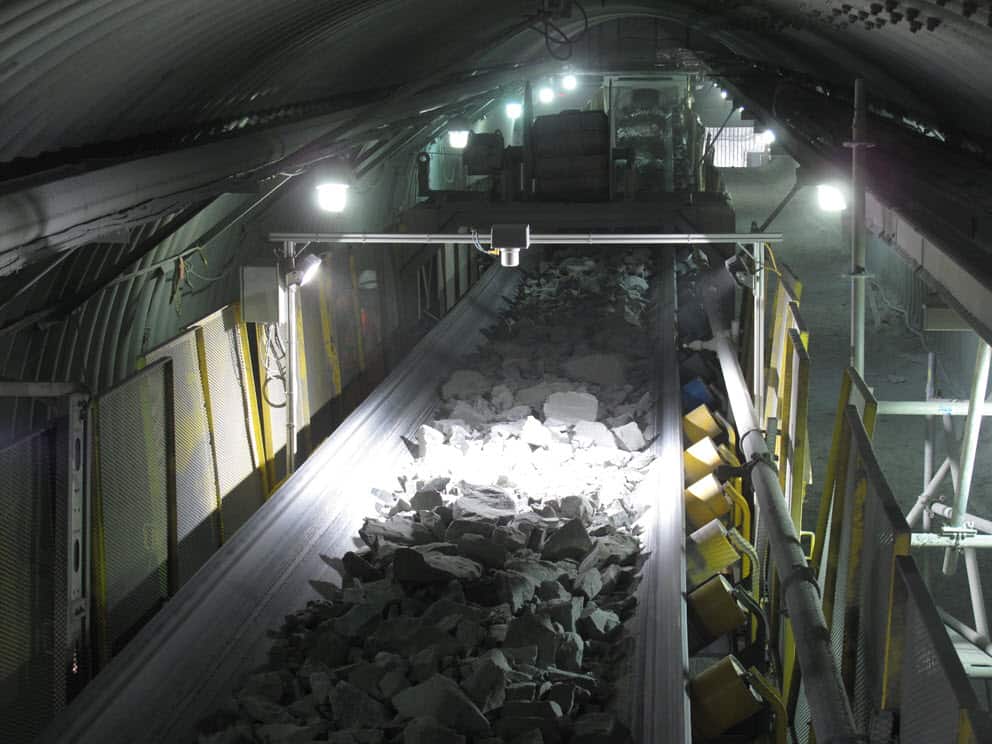
How can particle size measurements help improve industrial processes?
Over several decades, researchers and operators have used WipWare technologies to investigate relationships between fragmentation, material handling, crushing, grinding, and overall process performance.
Early applications focused on measuring rock fragmentation and comparing blasting results. Later research expanded into automated monitoring, process modelling, equipment control, and the evaluation of material characteristics at different stages of production.
This review highlights published research from 2000 through 2026, demonstrating how particle size measurements have supported practical decisions in mining, aggregates, and other industrial processes.
For earlier research from the 1990s, see WipFrag Case Studies: Research and Real-World Applications.
Early Applications of Automated Material Monitoring
Material Services Quarry — Comparing Stockpile and Conveyor Measurements
Illinois, USA | Aggregates | 2000
Research at Material Services Quarry evaluated the relationship between conventional stockpile image analysis and automated measurements of material moving through the processing circuit.
WipFrag was used to characterize stockpile particle size distributions, while an online camera-based measurement system provided repeated measurements of moving material.
The researchers reported close agreement between the two approaches.
The study also highlighted an important limitation of optical measurement: smaller particles become more visible when material is presented in a relatively thin layer or during free fall, rather than being buried beneath larger particles.
Key finding: Material presentation matters. The visibility of particles can influence measurement quality as much as the camera configuration itself.
INCO Copper Cliff — Monitoring Underground Fragmentation
Ontario, Canada | Nickel, copper and platinum-group elements | 2000
At INCO’s Copper Cliff operation, automated optical measurement was applied to material at underground drawpoints.
The objective was to characterize fragmentation from different underground sources and establish ongoing information about the material being extracted.
This application demonstrated how automated measurement could extend fragmentation assessment beyond occasional photographs of blasted material.
Key finding: Repeated measurements at underground material-handling locations can help characterize fragmentation variability between production sources.
Brunswick Mining — Two Different Process Applications
New Brunswick, Canada | Mineral processing and lead sinter | 2000
Research at Brunswick Mining documented two applications of continuous particle size monitoring.
The first involved monitoring feed to a new autogenous (AG) mill. Understanding the incoming particle size distribution was important for developing operating conditions that supported mill productivity.
The second application monitored lead sinter on conveyors. Here, particle size and uniformity were relevant to downstream furnace performance.
Both applications progressed to full-time monitoring, illustrating how similar measurement principles could support very different industrial processes.
Key finding: Continuous particle size measurements can support process optimization wherever material size and uniformity influence downstream equipment performance.
Particle Size Monitoring and Mill Performance
Hibbing Taconite — Identifying the Feed Sizes Affecting Throughput
Minnesota, USA | Iron ore | 2007
At Hibbing Taconite, researchers monitored particle size distribution on the conveyor feeding an autogenous grinding mill.
The objective was to understand how changes in feed size affected mill throughput.
The research identified an excess of material larger than 6 inches (approximately 152 mm) and insufficient finer material relative to the desired feed characteristics.
Regression analysis associated smaller feed fractions with higher throughput, while material exceeding the 6-inch threshold was associated with reduced throughput.
Key finding: Monitoring the complete feed distribution can help identify which particle size fractions are most relevant to mill performance—not simply whether the feed is generally coarse or fine.
United Taconite — Establishing a Mine-to-Mill Dataset
Minnesota, USA | Iron ore | 2007
United Taconite investigated run-of-mine fragmentation using automated measurements of truckloads delivered to the primary crusher.
The purpose was to connect measured particle size distributions with blast design and other operating variables.
At the time of publication, the findings were preliminary. The application was intended to establish a factual dataset for future mine-to-mill optimization.
Key finding: A reliable measurement baseline is an important first step toward understanding relationships between fragmentation and downstream performance.
Iron Ore Pellet Plants — Monitoring Greenball Size
Minnesota, USA | Iron ore pellet production | 2007
Research involving multiple pellet plants examined the use of automated particle size measurement in balling circuits.
In these applications, the material being measured was not blasted rock but greenball pellets formed during processing.
Particle size information helped operators evaluate and adjust balling parameters more quickly.
The research also identified opportunities to combine particle size measurements with moisture analysis and eventually support closed-loop process control.
Key finding: Automated particle measurement can support manufacturing and processing applications where product size consistency is important.
Xstrata Nickel Raglan — Supporting SAG Mill Control
Quebec, Canada | Nickel | 2008
The Raglan operation investigated ways to stabilize SAG mill performance using a multivariable fuzzy-logic control system.
The control strategy incorporated particle size information from the mill feed alongside crusher-gap information and other operating variables.
The published study reported controller availability exceeding 96% and a throughput improvement of approximately 3–6%, reaching up to about eight additional tonnes per hour.
The improvements were associated with the integrated process-control strategy, rather than particle size measurement alone.
Key finding: Fragmentation measurements become particularly useful when incorporated into process-control systems that can respond to changing feed conditions.
Chemical Lime Clifton — Comparing Online Measurements with Sieve Analysis
Texas, USA | Limestone | 2008
Chemical Lime investigated whether continuous photographic particle size measurements could provide information suitable for process control in place of relying exclusively on periodic belt cuts and sieve testing.
The research reported close trends between the optical and sieve-based measurements, with no significant overall differences under the study conditions.
The data was also used to support blast-design evaluation and the calibration of AggFlow process models.
Key finding: Automated particle measurements can complement physical sampling by providing more frequent information about material variability, provided the methods are appropriately evaluated and calibrated.
Minera Los Pelambres — Improving SAG Mill Performance Modelling
Coquimbo Region, Chile | Copper | 2011
Researchers at Minera Los Pelambres investigated how particle size distribution disturbances affected SAG mill performance.
Particle size measurements were incorporated into modelling work involving a fuzzy-logic controller.
The reported mean absolute modelling error decreased from 2.91% to 2.33%, demonstrating an improvement in the model’s ability to represent process behaviour.
This was a modelling result, not a reported equivalent percentage gain in physical mill throughput.
Key finding: Particle size information can improve process models, helping operations better understand and respond to changing material conditions.
Crusher Performance and Measurement Accuracy
Lafarge Ravena — Connecting Blasting and Crushing Performance
New York, USA | Limestone | 2012
At Lafarge Ravena, continuous fragmentation monitoring was used to investigate opportunities for improvement across drilling, blasting, and crushing.
Automated measurements characterized truckloads before primary crushing and material on the crusher discharge conveyor.
By comparing the incoming and outgoing particle size distributions, the operation could evaluate how changes in blast fragmentation affected crushing performance.
The study reported:
- 20% improvement in crusher productivity.
- 12% reduction in crushed-product cost per tonne.
- No significant increase in drilling and blasting costs.
Key finding: Measuring material before and after crushing can help operations evaluate fragmentation changes in relation to downstream productivity and cost.
Lafarge Bath — Using UAV Imagery to Evaluate Blast and Stockpile Fragmentation
Ontario, Canada | Limestone and aggregates | 2017
Research at Lafarge Bath investigated UAV-based fragmentation analysis for blast and stockpile assessment.
WipFrag measurements from aerial imagery supported the development of spatial particle size information, allowing researchers to evaluate differences across blast and stockpile areas.
The study also incorporated measurements of primary crusher output, supporting comparisons between incoming material characteristics and downstream processing.
The approach provided faster and safer access to fragmentation information while helping identify stockpile segregation and establish indicators for continuous improvement.
Key finding: Spatial fragmentation measurements can reveal variations that may be missed when results are represented by a single average particle size distribution.
Comparing WipFrag with Sieve Analysis
Particle size measurement research | 2018
A WipFrag correlation study compared optical particle size measurements with sieve analysis across different material size ranges.
The summary reports strong correlations for coarse and medium particles, with approximate R² values of 0.99 and 0.95, respectively.
The correlation was lower for fine material, approximately R² = 0.68, reflecting challenges associated with smaller particles being hidden beneath larger material.
Maximum and mean particle sizes generally showed strong agreement with sieve-based measurements.
These findings illustrate the importance of matching the measurement method to the particle size range and material presentation.
Key finding: Optical measurements can correlate closely with physical sampling, but their reliability varies with material conditions and the visibility of smaller particles.
Blast Optimization and Crusher Compatibility
Golden Girl Quarry — Reducing Oversize Through Blast Design
Edo State, Nigeria | Limestone and dolomite | 2022
Research at Golden Girl Quarry combined WipFrag fragmentation measurements with an artificial neural network (ANN) model to evaluate blast oversize and undersize.
The researchers examined how blast-pattern design, stemming length, and powder factor affected the resulting particle size distribution.
The study reported a 41% reduction in oversize material and a 22% increase in fragmentation meeting the intended size specification.
Key finding: Combining measured fragmentation results with predictive models can help evaluate blast-design adjustments intended to improve crusher compatibility.
Fanalou Dolomite Quarry — Comparing Fragmentation Prediction Models
Edo State, Nigeria | Limestone and dolomite | 2022
At Fanalou Dolomite Quarry, WipFrag measurements were used to evaluate blast fragmentation and compare different prediction methods.
The research examined artificial neural networks alongside established fragmentation models, including Kuz-Ram-based approaches.
The ANN model reportedly provided better predictions of mean fragment size under the studied conditions.
The research also evaluated fragmentation uniformity and used a crusher gape of 350 mm as a practical oversize threshold.
Key finding: Measured particle size distributions provide a basis for assessing the accuracy of fragmentation prediction models and their relevance to equipment requirements.
MOIL Dongri Buzurg — Routine Fragmentation Assessment
Maharashtra, India | Manganese | 2022
At the Dongri Buzurg manganese mine, researchers used WipFrag to evaluate post-blast fragmentation.
The study reported average percentile sizes of F10 = 93.6 mm, F30 = 192.5 mm, and F60 = 418.5 mm.
The researchers concluded that photographic analysis offered a practical way to obtain quantitative fragmentation information for routine blast assessment.
No downstream production improvement was quantified in the summary.
Key finding: Regular particle size measurements can establish the baseline needed to compare blast results and evaluate subsequent design changes.
Cherat Cement Quarry — Evaluating Post-Blast Fragmentation
Khyber Pakhtunkhwa, Pakistan | Limestone | 2022
Research at Cherat Cement Quarry used WipFrag to characterize blasted rock through particle size indicators including X50, F80, and F90.
The study examined photographic fragmentation analysis as an alternative to conventional physical sizing approaches.
The researchers concluded that photoanalysis was suitable for routine post-blast evaluation without interrupting quarry production.
Key finding: Image-based measurements can provide useful fragmentation indicators without requiring large-scale physical screening for every blast assessment.
Jebel Medjounes — Evaluating Blast Results Against Crusher Limits
Sétif, Algeria | Limestone | 2022
At Jebel Medjounes Quarry, researchers compared measured fragmentation with the Kuz-Ram empirical prediction model.
WipFrag was used to characterize the resulting particle size distributions and assess fragmentation performance.
The study reported that the measured blasts satisfied the operation’s maximum crusher feed size requirement of 1,000 mm.
However, the distributions still varied considerably, with reported median sizes ranging from approximately 134 to 198 mm.
Key finding: Satisfying a maximum crusher feed size limit does not necessarily mean that successive blasts produce identical or equally desirable particle size distributions.
Recent Research: Rock Structure, Blasting and Crusher Requirements
Karaisalı and Silifke Quarries — Connecting In-Situ Blocks to Blast Fragmentation
Çukurova Region, Türkiye | Limestone | 2025
Research at two Turkish limestone quarries examined the relationship between rock structure, blast fragmentation, and crusher compatibility.
WipFrag was used to characterize blasted material, while WipJoint supported the assessment of in-situ rock blocks before blasting.
At Karaisalı Quarry, reported size reduction ratios varied from approximately 67% to 82%, depending on bench conditions and blast design.
At Silifke Quarry, the best-performing blast produced approximately 98% of material smaller than 1,100 mm, while other blasts produced approximately 63–71% below that threshold.
The results illustrated substantial variability between blasts, even where operations shared similar objectives.
Key finding: Comparing pre-blast rock structure with post-blast particle size distributions provides a more complete basis for evaluating blast effectiveness.
dstgroup Nital Quarry — Developing a Mine-to-Crusher Framework
Braga, Portugal | Granite and aggregates | 2025–2026
A series of research papers examined how fragmentation measurement could help align blasting outcomes with primary crusher requirements.
WipFrag was used to analyze blasted material, including UAV-based measurements, while automated measurements helped characterize material reaching the crusher.
The researchers evaluated particle size distributions against a crusher compatibility envelope, identifying where excessive oversize or other undesirable size fractions could affect processing.
The work established a baseline, investigated changes to blast design, and evaluated subsequent fragmentation results.
In the published Part 3 retrospective, the initial design adjustments were associated with an 11% reduction in D80, a 19% decrease in maximum fragment size, a 21% improvement in fragmentation efficiency, and a 15% improvement in alignment with the crusher compatibility envelope.
Key finding: Evaluating blast fragmentation against actual crusher requirements can provide more meaningful design targets than attempting to produce universally finer material.
For a broader discussion of this measurement approach, see From Blast to Mill: Using Fragmentation Data to Improve Mining Performance.
WipJoint — Integrating Discontinuity Analysis and Blast Fragmentation
Limestone research | 2026
A 2026 research paper examined how rock-structure measurements could be combined with blast fragmentation results within a unified WipFrag workflow.
WipJoint was used to assess geological discontinuities and estimate in-situ block characteristics. Post-blast WipFrag measurements provided particle size distributions for comparison.
The summary reports an estimated in-situ block size of approximately 2,571 mm and a largest post-blast boulder of approximately 546 mm.
The researchers also calculated fragmentation reduction indicators and crusher compatibility measures.
These comparisons help characterize blast performance, but should not be interpreted as a direct before-and-after production improvement.
Key finding: Combining geological structure measurements with post-blast fragmentation analysis can help explain fragmentation outcomes and support better blast-design decisions.
Learn more in the WipJoint Guide.
Walker Aggregates Severn Quarry — Establishing a Continuous-Improvement Baseline
Ontario, Canada | Limestone and aggregates | 2026
Research at Walker Aggregates’ Severn Quarry applied a structured continuous-improvement approach to fragmentation and crusher compatibility.
WipFrag and WipJoint provided measurements of blast fragmentation and visible geological discontinuities.
The study examined D80, maximum particle size, fragmentation efficiency, and the distribution of oversize material.
It identified a concentration of oversize in the upper portion of the bench, while calibrated UAV and ground-based fragmentation results showed close agreement.
The research established a performance baseline for evaluating future improvements rather than reporting a completed program of production gains.
Key finding: Identifying where problematic fragmentation occurs—and measuring it consistently—can help operations develop more targeted blast-design improvements.
What These Studies Demonstrate
Across different industries, materials, and operating conditions, several lessons emerge.
1. Measurement should support a specific decision. Monitoring the complete particle size distribution may be valuable for process optimization, while maximum-size monitoring may be sufficient for a focused oversize-control application.
2. Material presentation and sampling matter. Camera resolution alone does not establish measurement accuracy. Particle visibility, scale, sample representativeness, and calibration must also be considered.
3. Fragmentation is connected to downstream performance. Particle size can influence crushing, grinding, handling, and process stability. However, identifying those relationships requires considering other operating variables.
4. Not every study is an optimization success story. Some demonstrate measurable improvements; others establish correlations, validate methods, or develop baselines for future work. All can contribute useful information when their limitations are understood.
5. Measurements become more valuable when connected. Combining blast fragmentation, geological structure, vehicle-load measurements, conveyor data, and processing information can help operations evaluate the broader behaviour of material throughout production.
From Research to Practical Application
WipWare continues to develop technologies that make fragmentation and material characterization more accessible throughout industrial operations.
WipFrag supports on-demand measurements in the field, laboratory, and through UAV imagery. Reflex provides automated vehicle-load measurements, while Solo provides repeated measurements of material on conveyors and processing lines.
Together, these technologies help operations move beyond isolated measurements toward a more complete understanding of material behaviour.
For practical guidance on where measurements can be useful, see From Blast to Mill: Using Fragmentation Data to Improve Mining Performance.
For the underlying geological and blast-design principles, see Understanding Rock Blasting and Fragmentation.
The objective remains the same as it was in WipWare’s earliest research: provide reliable measurements that help people understand their processes and make better-informed decisions.
Because you can’t manage what you can’t measure!
References
2000–2011: Automated monitoring and process control
- Online Fragmentation Analysis for Grinding and Crushing Control (2000).
- Size Matters on the Mesabi Range (ISEE, 2007).
- Evolution of SAG Mill Process Control at the Xstrata Nickel Raglan Operation (CMP, 2008).
- Photographic Stone Gradation Analysis – CLC (2008).
- Characterization and Modeling of Semi-Autogenous Mill Performance Under Ore Size Distribution Disturbances (IFAC, 2011).
2012–2018: Crusher performance and measurement validation
- Utilizing Continuous Photo Analysis of Fragmentation as a Blast Crush Improvement Tool – Lafarge Ravena (ISEE, 2012).
- Utilization of Aerial Drones to Optimize Blast and Stockpile Fragmentation (ISEE, 2017).
- WipFrag Sieve Correlation (2018).
2022: Blast fragmentation research
- Artificial Neural Network Technique as an Approach for the Prediction of Blast Fragment Oversize-Undersize (2022).
- Analysis of Blast Fragmentation Using WipFrag (2022).
- Improvement of Small-Scale Dolomite Blasting Productivity (2022).
- Fragmentation Analysis of Blasted Rock Using WipFrag (2022).
- Fragmentation Analysis Using Digital Image Processing and Empirical Model (KuzRam) (2022).
2025–2026: Integrated fragmentation and crusher compatibility research
- Evaluation of Bench Blast Reduction Ratio and Fragmentation Efficiency in Quarry Operations (FRAGBLAST, 2025).
- Optimizing Blast Design and Downstream Operations Through PSD Curve Analysis – Case Study in Stemming Material Effect (APS, 2025).
- Enhancing Blast Efficiency and Fragmentation Through PSD Analysis and First Comminution Stage Optimization (CIM, 2025).
- A Mine-to-Crusher Framework for Aggregate Operations – Part 1 (ISEE, 2025).
- A Mine-to-Crusher Framework for Aggregate Operations – Part 2 (FRAGBLAST, 2025).
- A Mine-to-Crusher Framework for Aggregate Operations – Part 3 (ISEE, 2026).
- Advancing Blast Fragmentation Assessment Using Geotechnical Discontinuity Analysis Within a Unified WipFrag Framework (ISEE, 2026).
- Crusher-Compatible Fragmentation: A DMAIC-Based Approach to Blast Optimization (ISEE, 2026).
The findings summarized above reflect the methods, operating conditions, and comparisons described in the respective studies. Reported performance improvements should not be interpreted as guaranteed results for other installations.
 WipWare