

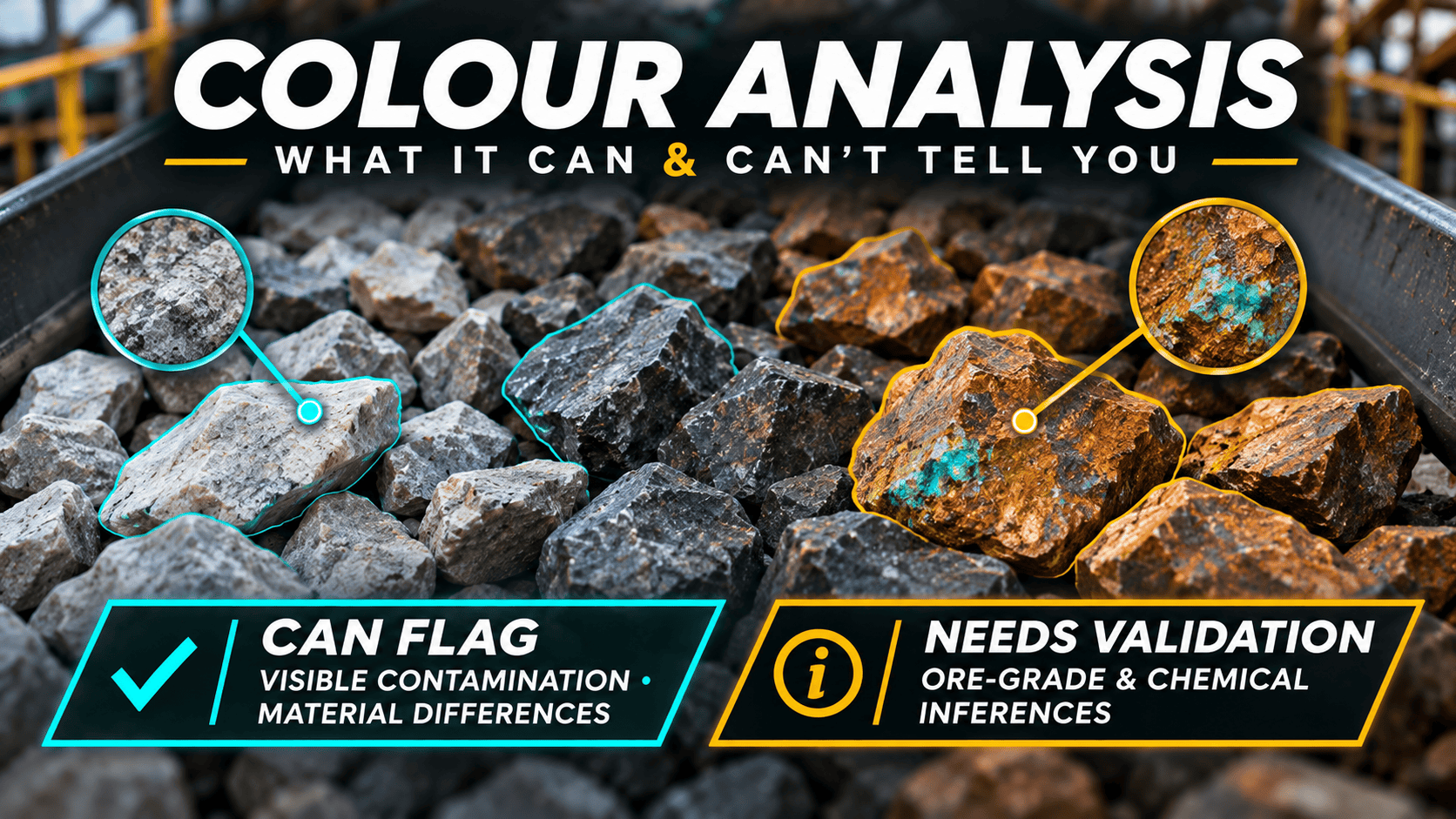
Colour analysis can help identify contamination, distinguish ore types, and support early grade estimation. Learn how WipWare uses colour measurements to monitor material characteristics, improve process decisions, and understand the limitations of visual analysis.
KEY TAKEAWAYS
- Colour analysis evaluates the visible characteristics of materials to support operational decisions in industries like mining.
- At Gibraltar Mine, colour analysis helps distinguish ore types based on their visible properties, aiding in early grade estimation.
- The system correlates colour measurements with downstream results, enabling useful insights without chemical analysis.
- However, colour analysis has limitations, such as not measuring elemental concentrations directly or distinguishing materials with similar appearances.
- Overall, understanding colour analysis can enhance material differentiation, contamination detection, and product consistency monitoring.
CONTENTS
•
What Does Colour Analysis Actually Measure?
•
Turning Colour Measurements Into Operational Information
•
Where Colour Analysis Is Useful
•
Where Colour Analysis Has Limitations
•
Factors That Influence Colour Measurements
•
How WipWare Uses Colour Measurement
•
Choosing the Right Measurement Method
•
•
Introduction
At Gibraltar Mine in British Columbia, WipWare camera systems are used to monitor visible colour characteristics in material moving along conveyors. These measurements help distinguish characteristics associated with higher copper-bearing ore, lower-grade ore, and miscellaneous material.
By correlating colour measurements with the grade of corresponding material further downstream, the operation has established a repeatable relationship that supports early, relative grade estimations. These estimates help operators prioritize feed material and manage lower-grade and waste materials more efficiently.
Importantly, the cameras are not directly measuring copper concentration. They are measuring visible characteristics that have been shown to correlate with grade.
This demonstrates an important principle: colour analysis does not need to determine a material’s exact chemical composition to provide valuable operational information.
In mining, aggregates, and other material-processing industries, visible differences can help distinguish materials, identify contamination, monitor product consistency, and support process control.
The key is understanding what colour analysis actually measures, how those measurements relate to material properties, and what information can reliably be obtained from them.
What Does Colour Analysis Actually Measure?
Colour analysis examines the visible appearance of material captured by a camera.
Digital images contain colour information for individual pixels. By evaluating this information against defined colour criteria, a measurement system can quantify how much of the observed material matches selected visual characteristics.
For example, consider a conveyor carrying predominantly dark material with occasional lighter-coloured fragments. A camera system can monitor the proportion of visible material matching the lighter-coloured profile.
Instead of relying on occasional visual observations, the operation receives numerical measurements that can be compared over time.
This allows operators to identify changes in material appearance, recognize trends, and investigate unusual conditions.
The measurement describes visible colour characteristics. The operational value comes from understanding what those characteristics mean in the specific application.
Turning Colour Measurements Into Operational Information
The Gibraltar Mine application demonstrates how colour measurement can extend beyond identifying differences in appearance.
WipWare’s conveyor systems monitor colour characteristics, including the relative presence of reddish and greenish material, as ore moves through the processing circuit.
These measurements are correlated with grade information obtained from corresponding material after further downstream processing.
Through this comparison, the operation has identified a repeatable relationship between the measured colours and relative copper grade.
This allows the colour data to serve as an early indicator of changing ore characteristics, providing information that can help operators make decisions before downstream grade measurements become available.
The resulting information supports several operational objectives:
- Early grade estimation: Identify relative changes in expected copper grade before downstream measurements become available.
- Feed prioritization: Use early indications of higher- and lower-grade material to support decisions about processing priorities.
- Waste management: Improve the identification and management of lower-value and waste materials based on established relationships with visible characteristics.
- Process monitoring: Compare colour trends with downstream grade and processing information to better understand changes in feed material.
The system does not perform a chemical assay, and the measured proportion of a particular colour does not directly equal copper concentration.
Instead, its value comes from the relationship established between an easily measured visual characteristic and material properties confirmed downstream.
By correlating colour measurements with downstream results, the operation can turn a visual observation into a practical indicator of ore quality.
This relationship is specific to the application and depends on the consistency of the material characteristics being monitored. It should not be assumed to apply universally to other deposits or operating conditions.
Where Colour Analysis Is Useful
Material Differentiation
Some operations handle materials with visibly different characteristics.
Mineralized material, host rock, and other geological materials may exhibit colour differences related to mineralogy, alteration, oxidation, or other physical properties.
Where these differences are sufficiently consistent, colour analysis can help distinguish material categories and monitor changes in their relative presence.
The Gibraltar Mine application is one example of using visible characteristics as indicators of differences in ore material.
Similar opportunities may exist in other mining operations where material categories have recognizable colour characteristics.
For example, some spodumene-bearing material in a lithium operation may appear lighter than surrounding waste rock. If representative testing establishes a reliable visual distinction, colour analysis may be useful for monitoring relative changes between these materials.
However, the relationship between colour and material type must be established for the specific application rather than assumed from the mineral or commodity being processed.
Contamination and Dilution Monitoring
Unexpected material can sometimes be identified through its appearance.
If a product stream normally contains material of one colour, the appearance of another distinct colour may indicate contamination, dilution, or a change in the incoming feed.
Automated colour measurement can help operators detect and quantify visible contamination as it occurs.
For example, a change in the proportion of visually distinct waste rock in an ore stream may provide an indication of increased dilution.
Likewise, aggregate producers may be able to identify unwanted material that differs visibly from the intended product.
Colour analysis can identify certain types of contamination directly when the unwanted material has a recognizable visual appearance. It does not necessarily require a separate chemical measurement to make that distinction useful.
Product Consistency
Colour can also be an important characteristic of finished products, particularly in aggregates and other industries where appearance matters.
Monitoring changes in colour profiles can help identify inconsistencies between batches, material sources, or production periods.
When combined with particle size measurements, colour information can provide a broader understanding of how the material is changing.
Where Colour Analysis Has Limitations
1. Direct Measurement of Mineral Composition or Chemical Grade
Colour analysis does not directly measure elemental concentrations, mineral composition, or chemical grade.
However, visible characteristics can sometimes correlate with these properties strongly enough to support useful estimates.
At Gibraltar Mine, for example, colour measurements have been compared with downstream grade results to establish a repeatable relationship. This enables early, relative grade estimations without directly measuring copper concentration at the camera.
Such relationships must be demonstrated through representative testing and evaluated as material characteristics and operating conditions change.
Two materials with similar appearances may have very different chemical compositions. Likewise, a single mineral or rock type may exhibit considerable colour variation.
Colour can serve as an indicator of grade-related differences without independently measuring grade itself.
Where direct determination of elemental concentrations or mineral composition is required, additional measurement methods remain necessary.
2. Materials Without Distinct Visual Characteristics
Colour analysis depends on meaningful differences in appearance.
If two materials have overlapping colour characteristics, the system may not be able to distinguish them reliably using colour alone.
Conversely, variations within a single material type may produce different colour measurements even when its underlying composition has not changed significantly.
For this reason, material classification through colour depends on the consistency of the visual characteristics being monitored.
3. Material Hidden Beneath the Surface
Camera-based analysis depends on the material visible in the image.
Particles beneath other material cannot be evaluated directly, and the measured percentage of a colour does not automatically represent the proportion of that material by mass throughout the entire stream.
This is particularly important when material segregation, overlapping particles, or uneven loading affects what the camera can observe.
Colour measurements should therefore be interpreted as measurements of the exposed material, with their relationship to the overall material stream evaluated for the application.
Factors That Influence Colour Measurements
Even where materials have distinct appearances, operating conditions can influence their measured colour characteristics.
- Lighting: Changes in intensity, colour temperature, shadows, or glare can alter how material appears to a camera.
- Moisture: Wet material may appear darker or more reflective than the same material when dry.
- Dust and surface coatings: Dust, mud, oxidation, and other coatings can change or conceal the underlying colour.
- Particle size and surface texture: Different particle surfaces may reflect light differently.
- Material presentation: Overlapping particles and uneven coverage influence which colours are visible to the camera.
These conditions do not necessarily prevent useful measurement, but they must be considered when designing and evaluating an application.
Consistent lighting and material presentation are particularly important for automated systems expected to compare measurements over time.
In applications where colour is being used to distinguish material categories or estimate other properties, representative testing should account for the range of material and operating conditions likely to occur.
Jump to:
•
What Does Colour Analysis Actually Measure?
•
Turning Colour Measurements Into Operational Information
•
Where Colour Analysis Is Useful
•
Where Colour Analysis Has Limitations
•
Factors That Influence Colour Measurements
•
How WipWare Uses Colour Measurement
•
Choosing the Right Measurement Method
•
•
How WipWare Uses Colour Measurement
WipWare provides colour measurement capabilities across its software and automated analysis systems.
WipFrag allows users to define up to two Colour IDs during image analysis and measure the proportion of visible material matching those profiles. This can support material differentiation, visual contamination assessment, and comparisons between samples.
Solo provides automated colour monitoring on conveyors, allowing operations to track changes in visible material characteristics as material moves through a process. Measurements can be incorporated into reporting, alarms, and plant control systems to support operational decisions.
Reflex extends colour monitoring to vehicle loads, helping operations compare visible material characteristics between trucks, loaders, and other measured loads.
Depending on the application, colour measurements can be used independently or alongside particle size, shape, and other available measurements.
Rather than simply reporting differences in appearance, these measurements can become useful process indicators when they are connected to established material characteristics and operating objectives.
For information on interpreting WipFrag colour results, see the WipFrag Results Interpretation Guide.
Choosing the Right Measurement Method
The most important consideration when evaluating colour analysis is not simply whether two materials look different, but whether those differences provide useful information for the intended application.
Start by identifying which materials or conditions need to be distinguished and whether their appearances remain sufficiently consistent under normal operating conditions.
Next, establish how the measured colours relate to the characteristic of interest. This may involve comparing colour measurements with material samples, laboratory results, or existing process information.
For applications involving grade estimation or other indirect measurements, it is particularly important to establish a repeatable relationship between the colour measurements and independently verified results.
Finally, determine what action the operation can take when the measurement changes.
An application may only require an indication that unexpected material has entered a conveyor stream. Another may use colour trends alongside particle size and other measurements to support more detailed process decisions.
Where colour provides a sufficiently reliable indicator, camera-based measurement can offer an efficient means of monitoring material characteristics.
Where the objective requires direct determination of mineral composition, elemental concentration, or chemical grade, complementary technologies such as spectroscopy, X-ray methods, or laboratory analysis may be necessary.
The Bottom Line
Colour analysis can be much more than a measurement of appearance.
It can help identify material differences, detect contamination, monitor product consistency, and provide early indications of changing material characteristics.
As demonstrated at Gibraltar Mine, colour measurements can even support relative grade estimations when a repeatable relationship with downstream measurements has been established.
The effectiveness of colour analysis depends on identifying meaningful visual characteristics, understanding their relationship to the material or process, and using that information to support operational decisions.
Colour analysis measures what the camera sees. Its value comes from understanding what those measurements tell you about the material and your process.
Jump to:
•
What Does Colour Analysis Actually Measure?
•
Turning Colour Measurements Into Operational Information
•
Where Colour Analysis Is Useful
•
Where Colour Analysis Has Limitations
•
Factors That Influence Colour Measurements
•
How WipWare Uses Colour Measurement
•
Choosing the Right Measurement Method
•
 WipWare