Autor: kim coyle

Solo

¿Dónde debo instalar la tecnología WipWare?

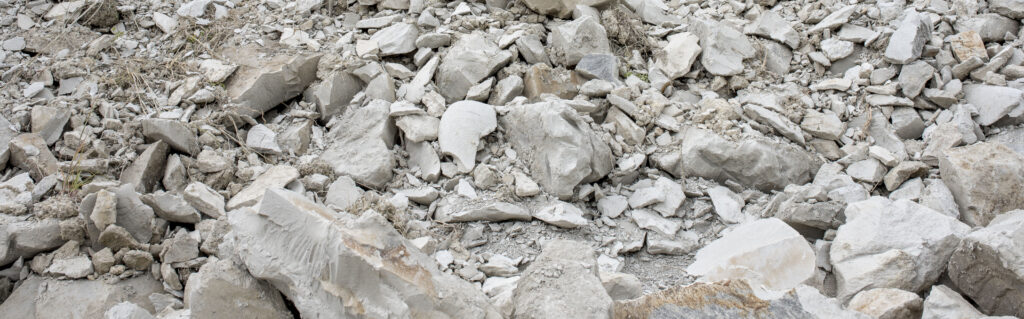
Image of a rock pile with large boulders

¿Eres nuevo en la tecnología de fotoanálisis? ¿Quizás tiene una instalación y le gustaría investigar otras ubicaciones para mejorar la eficiencia? Siga leyendo más allá del salto para conocer algunas de las ubicaciones más populares de WipWare.

Where would be an ideal location to install your technologies?

There are 5 main locations where photoanalysis technologies are installed, all of which have a similar theme of analyzing material after it has been reduced in size. I’ve listed a few (of the many) popular locations, from the mine to the mill:

Blast Fragmentation

Unlike conveyor belt technologies, blast fragmentation systems are providing particle sizing data that would otherwise be unquantifiable. As an example: When mine team is asked how they were determining blast performance, they responded with: “Well, we try to compare it just by looking at it”. By putting quantifiable values beside the material being dumped into the primary crusher, we eliminate any bias and baseline the blasting performance.

Now, think for a second how much cheaper it would be, if you could do most of your material breaking in the blasting phase: Reduced crusher needs, less maintenance on equipment, and significantly reduced energy costs to name a few of the benefits of optimizing blasting procedures.

Post-primary/Post-secondary crusher

 Either Jaw, Gyratory, or Cone, whatever type of crusher you use to break down your material, if it’s primary, secondary or tertiary crushing, you should be looking into evaluating the performance of those crushers, in order to a) maximize liner life, b) make crusher gap adjustments, c) change worn out liners before oversize contaminates your stockpile, d) improve overall crusher throughput.

See, most crusher maintenance schedules are based on a fixed timeline, when many variables can affect the lifetime of the liners. Think ore hardness, size, etc.

De hecho, volviendo a una publicación de blog anterior, puede comenzar a automatizar esa parte de su proceso para lograr la máxima eficiencia.
Screen Breakages

Si necesita una rotura inmediata de la pantalla o indicadores de desgaste, las tecnologías de fotoanálisis pueden detectar extremadamente bien el material de gran tamaño después de la detección. Los productores agregados, por ejemplo, ven un valor significativo en la identificación de material fuera de especificación inmediatamente después de que se haya identificado una falla en la pantalla.

SAG Optimization

This is probably the location with the biggest potential return on investment, and is the most common first installation: Imagine controlling your stockpile blend based on continuous particle sizing information. Being able to optimize SAG feed can save an operation significant cost in a variety of areas.

Sepa cuándo alimentar desde los lados más gruesos de la pila o desde el medio.

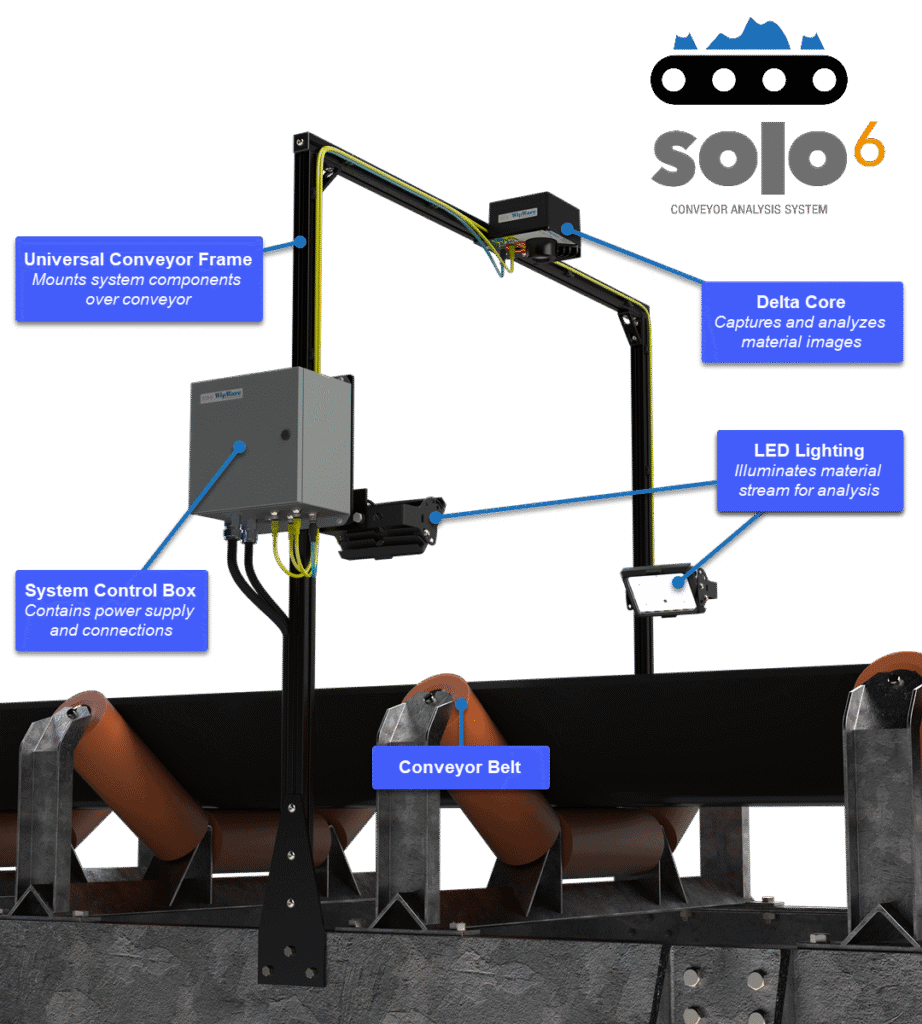
Want to read more about our conveyor analysis systems? Click here: https://wipware.com/products/solo-conveyor-analysis-system/

Looking for more information: See our Blast Fragment Optimization LinkedIn Page: https://www.linkedin.com/groups/12895040/
WipFrag

Effect of Excessive Burden Distance on Blasting Result – Part 2

What happens to your blast fragmentation when you have excessive inter-row distance (burden)?

Introduction – Excessive Burden

According to Prasad et al. (2017), rock fragmentation size is a very important parameter for an economical point of view in any surface mining. Excessive inter-row distance, often referred to as an increased burden in blasting operations, can occur due to poor drilling operation (human factor, machine factor).

Applying Chapman–Jouguet (CJ) Condition:

The CJ condition holds approximately in detonation waves in high explosives. It states that the detonation propagates at a velocity at which the reacting gases just reach sonic velocity as the reaction ceases. In such case, excessive burden affects explosive energy distribution by diminishing the efficiency of the explosive shock wave travel, which impacts the creation of micro-cracks.

CJ Plane Theory

According to the CJ plane theory, an optimal burden ensures effective shock wave propagation and micro-crack formation, crucial for breaking rock.

With excessive burden, energy dissipates before adequately fracturing the rock, leading to poor fragmentation. This inefficient energy transfer disrupts the detonation process, reducing the effectiveness of the blast and resulting in larger, unbroken rock pieces.

Burden Distance Affects Rock Fragmentation

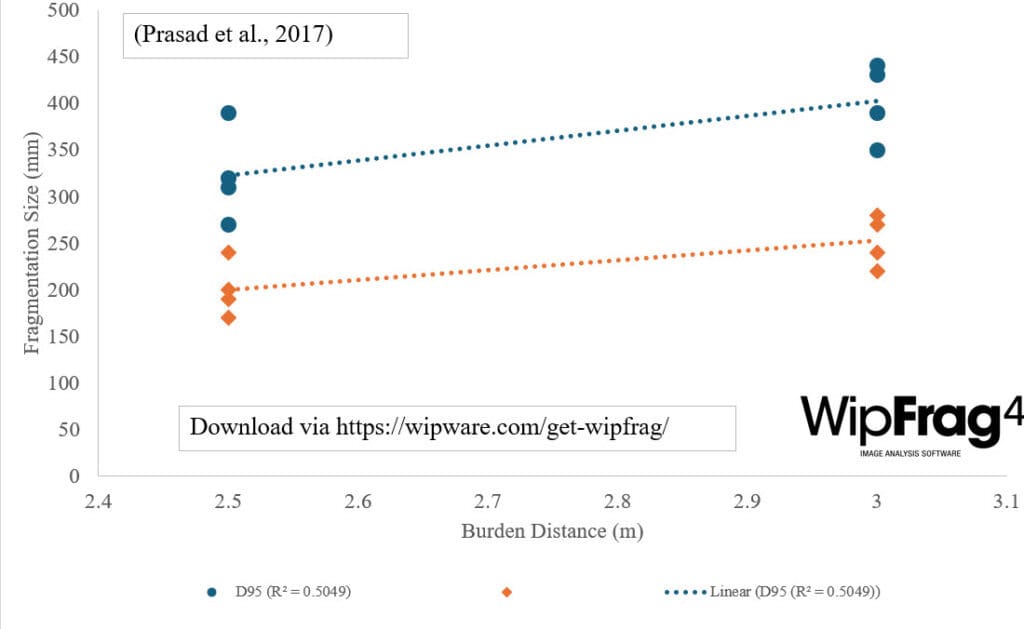
This article makes use of data from Prasad et al. (2017) to explain further the effect of burden increments from 2.5 to 3m. As shown by the regression line, the analysis revealed that the blast fragmentation size (D50 and D95) increases with more than 50% positive correlation.

This shows that, the larger the burden distance, the bigger the rock fragment generated from the blast. Having excessive burden with the same powder factor will definitely affect the fragmentation size and shape. To account for how your current burden is affecting your fragmentation, you should first assess your borehole condition before charging.

Furthermore, assess your blast results using image analysis software. WipFrag software is the most highly recommended blast assessment software, with a long history in addition to the latest technological innovation. The software offers significant advantages in assessing mine burden effects on fragmentation. Using the app on mobile phones allows for convenient, on-site analysis.

Deep Learning Capabilities

Deep learning capabilities save analysis time by quickly processing images. The boulder detection tool identifies oversized fragments, while the specification envelope helps correlate blast results with downstream primary crusher performance, ensuring optimal fragment sizes for efficient crushing and improved overall operational efficiency.

Follow for Part 3 – You can also find all three parts on Giant Miner’s Facebook page: https://www.facebook.com/GiantMiner

Referencias

Prasad, S., Choudhary, B. S., & Mishra, A. K. (2017, August). Effect of stemming to burden ratio and powder factor on blast induced rock fragmentation–a case study. In IOP conference series: materials science and engineering (Vol. 225, No. 1, p. 012191). IOP Publishing.

Download WipFrag at https://wipware.com/get-wipfrag/

For Part 3 click here: https://wipware.com/effect-of-excessive-burden-distance-on-blasting-result/

Missed Part 1? Here you go: https://wipware.com/effect-of-excessive-burden-distance-on-blasting-result-part-1/

WipFrag

Effect of Excessive Burden Distance on Blasting Result – Part 1

Excessive burden in blasting refers to having too much rock mass in front of the blast holes. This is relative to the designed blast parameters. The burden is the distance between a blast hole and the free face.

If this distance is too large, it can significantly impact the efficiency and effectiveness of the blasting operation. Here are some effects and consequences of excessive burden:

1. Incomplete Fragmentation:

When the blast design has too much burden distance between rows, the explosive energy may not be sufficient to break the rock effectively, leading to large, unbroken boulders or slabs.

Rocks

2. Higher Vibration and Noise:

Relating ground vibration to this phenomenon, excessive burden can cause more energy to be transferred to the ground as vibrations, potentially causing damage to nearby structures and creating safety hazards (Blair & Armstrong, 2001).

On the other hand, inadequate burden can result in higher levels of air overpressure and noise, affecting the environment and nearby communities.

It’s worth noting that when there is excessive burden in blast design, the energy from the explosives is not used efficiently, leading to wasted explosive material and higher operational costs.

3. Flyrock Hazards:

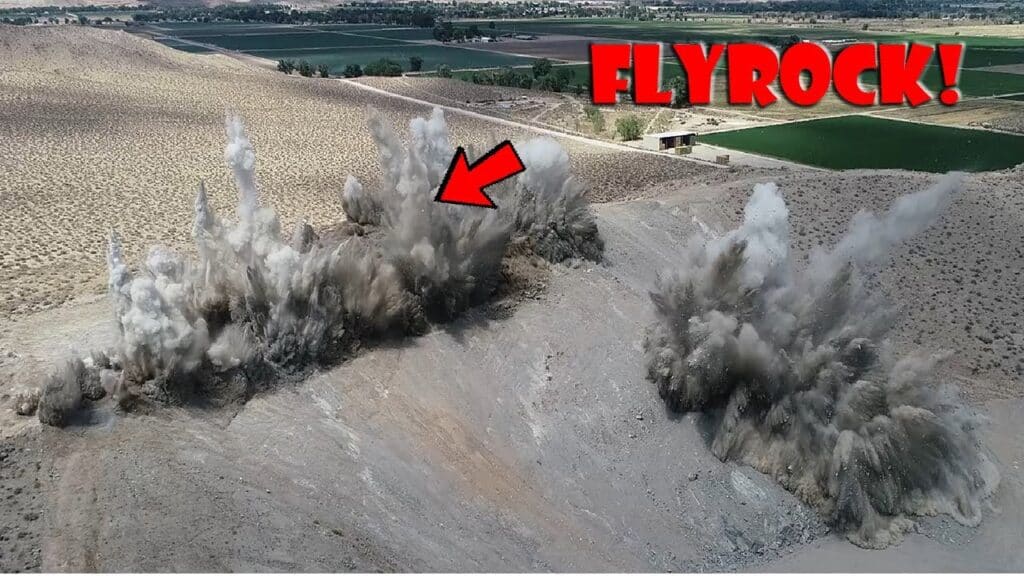
Excessive burden can cause unpredictable flyrock, posing significant safety risks to workers and equipment.

rock blasting into the air with pieces of rock flying up

4. Inefficient Loading and Hauling:

The resulting muckpile from an overburdened blast may have uneven fragmentation. This makes it harder to load and transport the material efficiently.

5. Incomplete Detonation and Misfires:

Excessive burden can cause incomplete detonation of explosives. This leads to misfires and the need for re-blasting, which adds to safety risks and costs.

Conclusión

In their paper for the 2nd World Conference on Explosives and Blasting Technique in 2003, Onederra and Esen stated that there is usually a discrete element of time that has elapsed from the time of explosive detonation to mass burden displacement. This time is designated as the minimum response time (Tmin) and is dependent on the burden mass, explosive and dynamic material response to the explosive stimulus. Generally, but not always, Tmin can be decreased by employing small burdens, using higher energetic explosives or a combination of both.

Referencias

Blair, D. P., & Armstrong, L. W. (2001). The influence of burden on blast vibration. Fragblast, 5(1-2), 108-129.

Onederra, I., & Esen, S. (2003). Selection of inter-hole and inter-row timing for surface blasting—an approach based on burden relief analysis. In Proceedings of the 2nd world conference on explosives and blasting technique, Prague. Taylor & Francis (pp. 269-275).

Read more – Part 2: https://wipware.com/effect-of-excessive-burden-distance-on-blasting-result-part-2/

Download WipFrag at https://wipware.com/get-wipfrag/. Assess your blasting results, spot regions with poor fragmentation and trace back to your drill and blast design.

Visit Giant Miner’s Facebook page for more information about WipFrag 4 capabilities: https://www.facebook.com/GiantMiner

WipFrag

WipFrag 4 New Features

Heat Map with colours from blue to red rocks

A Quick Summary on WipFrag version 4 and its New Features

Overview

Mining is the extraction of valuable materials called ore or sometimes industrial minerals from the earth crust, using appropriate technology with the aim to provide raw materials for industrial use.

The materials exist in massive form and must therefore be broken into handable size through blasting operation or other safe and productive ways. The use of explosive to break rock into smaller sizes had been adopted several years due to it well know advantages.

Image analysis had been proven as the way forward to enhancing blasting and improving downstream operation efficiency through accurate visualization. Image analysis is a technique use to evaluate blasting output and to monitor material flow during mineral processing.

WipFrag Image Analysis software is a powerful tool for analyzing particle size distribution (PSD) in digital images collected from various blast muck-pile, including fresh phase muckpiles after blasts, time series stockpile samples, and even drone or UAV images.

Features and Advantages

Let’s delve into its features and advantages:
1. Instant PSD Analysis: WipFrag 4 provides instant PSD analysis of the captured images. Whether you’re assessing post-blast muckpiles or analyzing stockpile samples, this software delivers accurate fragmentation data.

Chart showing PSD analysis of material


2. Auto-Scaling Capabilities: With auto-scaling capabilities, WipFrag 4 ensures precise measurements. It’s a cost-effective solution that saves time and resources.

3. Cross-Platform Compatibility: Seamlessly analyze images across multiple platforms, including iOS, Android, and Windows. Share results effortlessly and optimize blast performance.

4. BlastCast Blast Forecast Module: This module, included in the software, helps predict fragmentation when used alongside WipFrag particle size data. It’s a valuable tool for blast planning.

5. Deep Learning Edge Detection: This amazing tool will increase accuracy from our previous Simple edge detection and almost eliminate the need to manually edit your images.

6. Integration with WipWare Photoanalysis Systems: WipFrag 4 also controls sixth-generation WipWare Photoanalysis Systems. Monitor conveyor belts or heavy-duty vehicles in real time, providing continuous particle size data to your portable device 24/7.

WipFrag Software Options Available

WipFrag 4 offers flexible licensing options to suit different operational needs, whether you require continuous blast fragmentation analysis or occasional assessments. Here’s a quick overview of what’s available:

1. Annual Subscription

Ideal for operations requiring consistent fragmentation analysis, the annual subscription allows up to 10 simultaneous device activations per license. This is a cost-effective solution for teams working across multiple sites or needing frequent analysis.

2. Pay-Per-Use (PPU) Option

For users who need WipFrag on a project basis or for occasional assessments, the PPU image credit is a great option. This model offers flexibility, enabling you to pay only when you use the software without committing to an annual plan.

3. UAV/Orthomosaic Image Analysis:

This is included in the annual subscription with unlimited analyses for the year. If credits are preferred, a minimum of 3 credits is required to unlock the analysis results. Number of credits is determine by hectare.

4. MailFrag Single or UAV/Orthomosaic Image Analysis:

MailFrag is our online service when customers need a third party to analyze their images. Single image analysis is 3 credits and UAV/Orthomosaic image analysis is a minimum of 9 credits based on hectare. MailFrag is only available for use with credits. It is not included as an option with the annual subscription.

Chart that shows pricing for WipFrag

Which License is Right for You?

If you’re unsure which license best fits your needs, contact us to discuss your application and explore the best solution for your operation. Whether you need continuous monitoring or occasional analysis, WipFrag has an option that works for you!

Remember that credits can be transferred to other WipWare Account users. Additionally, UAV/orthomosaic images must be analyzed with the Windows version and be in GeoTIFF format.
In summary, WipFrag 4 offers a cost-effective and accurate solution for fragmentation analysis, making it an essential tool for professionals in various industries.

Multiple Language Options

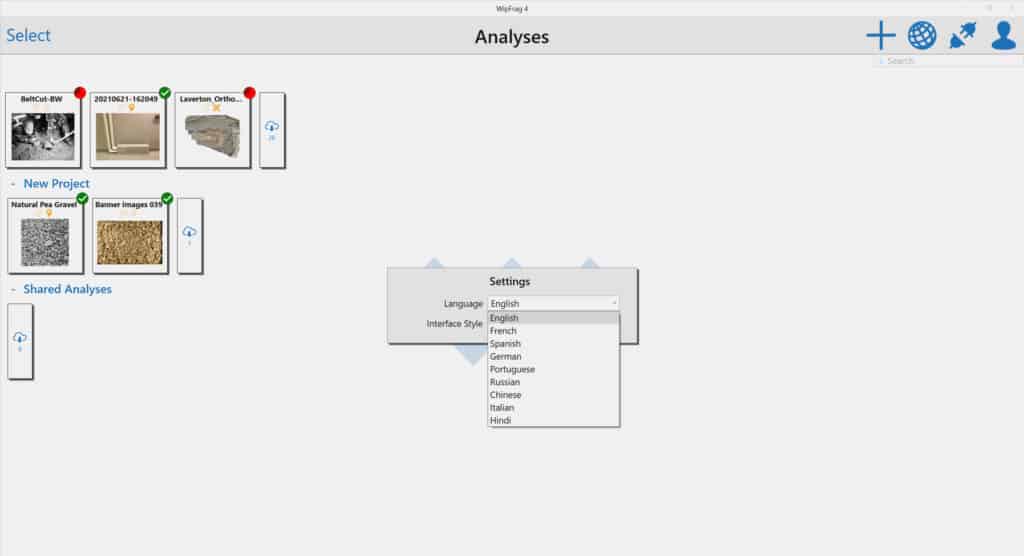
WipFrag 4 has multiple language options available for our customers. The following nine languages are now available:

Inglés, francés, español, alemán, portugués, ruso, chino, italiano e hindi.

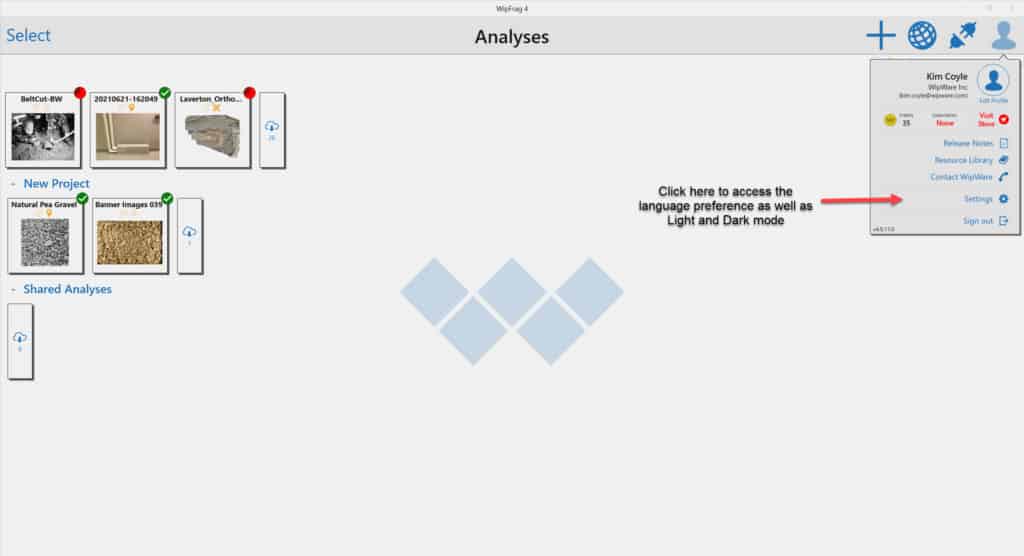
Para cambiar su preferencia de idioma en WipFrag 4, siga estos pasos:

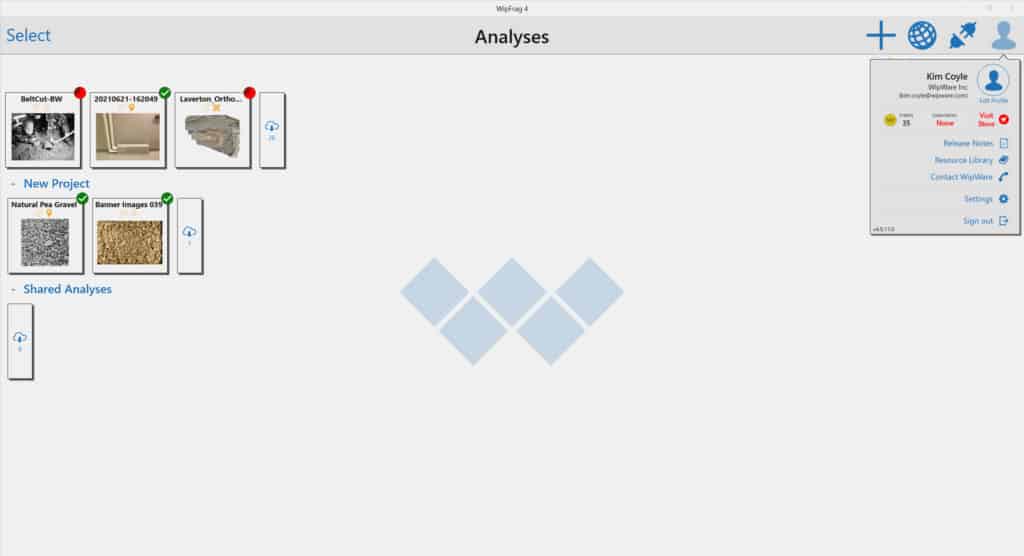
Click on your Profile Icon

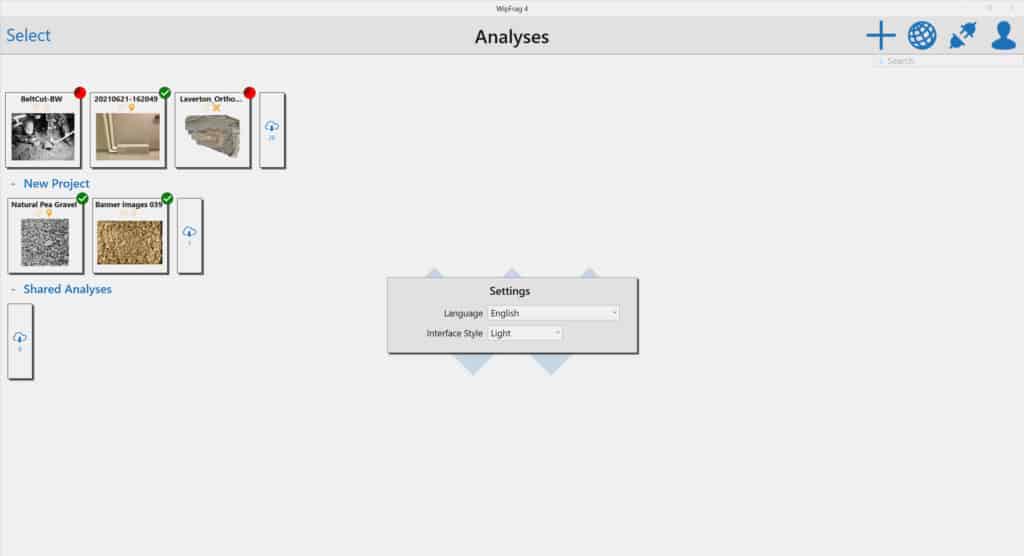
Haga clic en el botón Configuración

In Settings, click on Language to access the drop-down menu

En el menú desplegable, hay 9 opciones de idioma disponibles

Para obtener más información sobre nuestro software de análisis de imágenes WipFrag 4, visite nuestro WipFrag page.

Solo

Understanding Size Ranges in Conveyor Belt Analysis

How Low Can You Go?

One of the most common questions we receive is, “How small can you analyze?” The answer depends on multiple factors, but with the right imaging, WipWare’s systems can measure down to micron levels. However, when analyzing material on conveyor belts, additional considerations impact the minimum particle size that can be accurately measured.

Over the years, we’ve worked with a vast range of conveyor belt applications from highly quality-controlled 10-inch belts to massive run-of-mine conveyors that are several metres wide as is normally found in global copper, iron ore mine operations. Our fully adjustable frames are customized before shipping to ensure seamless integration into your operation.

Key Considerations for Conveyor Belt Analysis

When it comes to analyzing material on conveyor belts, a few fundamental factors come into play:

  • Fixed Camera Position – The camera is mounted at a consistent distance from the belt, usually within a metre or so (a few feet).
  • Controlled Lighting – Conveyor belt environments generally offer stable lighting conditions, improving image accuracy.
  • Material Spread – The material stream typically covers a predictable portion of the belt rather than the entire conveyor surface, allowing the camera to focus specifically on the material.
  • Controlled Flow – Conveyed material has a known source and destination and moves at a controlled speed and direction, making variables easier to control.

With these stable conditions, WipWare’s systems can precisely determine the size ranges they analyze for each application.

Real-World Examples

Let’s explore two real-world examples using WipWare’s Solo system:

CompañíaABC CompanyXYZ Company
Material TypeCopperGold
Conveyor Dimensions3 metres / 10 feet1.2 metres / 4 feet
Analysis LocationPrimary crusher outputSAG mill feed
Detectable Sizes7.14 mm – 609.6 mm
0.2812 in (~#3) – 24 in
2.86 mm – 243.84 mm
0.1125 in (~#7) – 9.6 in

From the comparison table above, we see that ABC Company’s larger conveyor widths require the particle sizing system to be mounted higher to capture the full material spread. This setup means the system focuses more on coarser size fractions than fines – which is good: If a 3-metre belt is in use, and the material is raw primary crusher output, it’s unlikely that the material is 100% fines.

In contrast, Company XYZ deals with crushed and pre-screened materials, meaning the belt carries smaller particles. Since the conveyor is smaller in width, the system mounting height is closer to the material and can therefore analyze smaller size fractions.

Note: These are real-world examples with their own unique challenges which affect the detectable size range and goals which determine the focus of data collection. Your own application could have very different detectable size ranges depending on similar factors at your operation.

Expanding the Size Range: What are the options?

If you need to adjust the minimum or maximum detectable particle size, consider the following:

  1. Calibrate for Unseen Fines – Using sieve data and manual belt cuts to measure unseen and unresolvable fines and calibrate the system output accordingly. This is good for known and predictable material streams.
  2. Reduce the Field of View – Narrowing the system’s focus by adjusting the position or changing the type of lens used to view a smaller area. This in turn may limit the ability to capture coarser sizes.
  3. Increase Camera Locations – Using multiple cameras on the same material stream to capture different ranges of material, ie. a “fines” camera and a “coarse” camera.
  4. Tailored Solutions for Your Operation – The technology itself can change for your specific needs, such as increasing the camera resolution or changing the mounting solution.

If you’re wondering how effective a WipWare analysis system would be for your operation, Contáctenos! Our technologies have helped mining operations worldwide achieve better process control.

Have a unique application? We love a challenge — send us the details, and we’ll be happy to assist!

Instalaciones

Revisión bibliográfica: Aplicación de la tecnología WipWare

Blast on a bench face

Tecnologías de análisis de fragmentación de WipWare Se han aplicado ampliamente en diversas operaciones mineras para resolver retos críticos. Estos estaban relacionados con el flujo de materiales, la consistencia de la fragmentación, el uso de energía y la eficiencia general del proceso. Me encontré con tom palangio‘Sus trabajos sobre numerosos casos prácticos destacan la eficacia de WipWare‘. Estas herramientas optimizaron las prácticas de chorro y el procesamiento posterior. Esta reseña presenta un resumen de varios estudios influyentes y aplicaciones industriales de la tecnología WipWare.

Análisis de fragmentación fotográfica

Mina Selbaie, Joutel, Quebec, Canadá

A mediados de la década de 1990, la mina Selbaie utilizó el análisis de fragmentación fotográfica mediante WipFrag evaluar el rendimiento de los explosivos y optimizar los patrones de voladura. La integración de la tecnología WipWare permitió a la mina supervisar y controlar varios indicadores clave de rendimiento. Algunos de estos indicadores incluían el consumo de energía para la trituración, las tasas de carga, las cargas útiles de los camiones de transporte, los costos de voladuras secundarias y los gastos de mantenimiento. Los datos de fragmentación revelaron una comprensión más completa de los efectos de los resultados de las voladuras en las estructuras generales de costos de la minería. Esta información permitió a la mina gestionar mejor las operaciones de procesamiento de mineral. Pudieron cuantificar el costo real de la manipulación de minerales en función del tamaño de los fragmentos.

Optimización significativa de patrones

Mina INCO Coleman, Sudbury, Ontario, Canadá

La mina Coleman de INCO utilizó WipFrag durante un estudio detallado en 1994, lo que dio como resultado una mejora significativa del patrón. El patrón de voladura original (1,5 m x 3 m) produjo un tamaño característico (Xc) de 0,617 m, con una cantidad considerable de material de gran tamaño que requería una nueva voladura. La expansión progresiva del patrón de voladura a 6 pies x 10 pies y, finalmente, a 7 pies x 10 pies no solo mejoró la fragmentación (Xc = 0,318 m), sino que también redujo por completo el exceso de tamaño. Los datos de WipFrag fueron fundamentales para determinar la fragmentación óptima, lo que permitió a INCO lograr una expansión del patrón de voladura de hasta 401 TP3T y un ahorro de costos de 801 TP3T. Además, la tecnología permitió reducir la generación de finos, lo que agilizó aún más la manipulación del mineral y mejoró la calidad de la alimentación de la trituradora.

Correlacionar la fragmentación y la dureza del mineral con el rendimiento del molino

Highland Valley Copper, Logan Lake, Columbia Británica, Canadá

En Highland Valley Copper (HVC), el equipo utilizó las herramientas de WipWare para correlacionar la fragmentación y la dureza del mineral con el rendimiento del molino. El software WipFrag de WipWare, el sistema de análisis de vehículos Reflex y el sistema de análisis de transportadores Solo desempeñaron un papel fundamental en el seguimiento de la distribución del tamaño del mineral desde la mina hasta la alimentación del molino. Esto permitió optimizar en tiempo real los ajustes de la trituradora y el molino. El sistema de despacho de la mina integró los datos de fragmentación para guiar la gestión de las reservas y minimizar la segregación de la alimentación. El análisis de WipFrag reveló que la consistencia de la alimentación en las líneas de molienda podía mejorarse ajustando las proporciones del alimentador. Esta capacidad de cuantificar los efectos de la fragmentación permitió a HVC realizar análisis de costo-beneficio y optimizar el equilibrio entre la calidad de la voladura y el rendimiento del molino.

Precisión en la sincronización del detonador y fragmentación mejorada con WipFrag

Bartley y Trousselle – Ogdensburg, Nueva York, EE. UU.

En Benchmark Materials Quarry, Bartley y Trousselle demostraron la relación entre la precisión de la sincronización de los detonadores y la mejora de la fragmentación utilizando WipFrag. Los detonadores digitales programables proporcionaron una uniformidad de explosión superior y redujeron los niveles de vibración. El análisis de imágenes de WipWare facilitó la evaluación de las mejoras en el rendimiento de la explosión al proporcionar datos precisos sobre la distribución del tamaño de la fragmentación.

Los efectos de la mejora de la fragmentación en el rendimiento mecánico y el consumo de energía en el circuito de trituración

Lafarge Canada Inc. – Exshaw, Alberta, Canadá

Las operaciones de Lafarge en Exshaw aplicaron WipFrag para examinar los efectos de la mejora de la fragmentación en el rendimiento mecánico y el consumo de energía en el circuito de trituración. Una voladura rediseñada con perforaciones de 102 mm dio lugar a una fragmentación más uniforme. Esto se tradujo en un aumento de 161 TP3T en el rendimiento de la trituradora y una reducción de 301 TP3T en el consumo de energía. Los datos de WipWare también sirvieron de base para tomar decisiones relacionadas con la selección de equipos (por ejemplo, brocas) y el control de paredes, lo que mejoró la seguridad y redujo los impactos de las vibraciones en las comunidades vecinas.

Herramienta de evaluación de fragmentación rentable y confiable

Barkley y Carter: Evaluación de los métodos ópticos de medición del tamaño.

Barkley y Carter evaluaron WipFrag como una herramienta de evaluación de fragmentación rentable y confiable. Su trabajo destacó que los esfuerzos previos de optimización de voladuras se veían limitados por la falta de técnicas de dimensionamiento eficientes. Por el contrario, WipFrag permite tomar decisiones significativas en el modelado de voladuras, la selección de métodos de minería y la planificación económica. El estudio subrayó la importancia de la frecuencia de muestreo basada en imágenes, especialmente en condiciones variables de pilas de escombros, para obtener información útil sobre el rendimiento de la trituradora y la consistencia de la alimentación.

Evaluar la fragmentación y la uniformidad del stemming

Chiappetta, Treleaven y Smith: ampliación del Canal de Panamá

Durante la ampliación del Canal de Panamá, se utilizó WipFrag para evaluar la fragmentación y la uniformidad del relleno en condiciones geológicas y logísticas complejas. La integración de WipWare en las operaciones de voladura permitió a los ingenieros realizar un seguimiento de los resultados de las voladuras y tomar decisiones de diseño adaptativas en tiempo real. En un proyecto caracterizado no solo por el tráfico marítimo, sino también por zonas saturadas y plazos ajustados, la tecnología proporcionó un apoyo esencial para lograr una fragmentación controlada y una manipulación predecible de los materiales.

Conclusión

Estos casos prácticos revisados destacan el papel fundamental de WipWare en la mejora de la eficiencia y la economía de las operaciones mineras. Mediante un análisis preciso y en tiempo real de la fragmentación, las tecnologías de WipWare facilitan la optimización en toda la cadena de valor, desde la mina hasta la planta de procesamiento. Desde la reducción del consumo de energía y el desgaste de los equipos hasta la mejora de los diseños de voladuras y la minimización de los finos, las tecnologías de WipWare ofrecen soluciones sólidas a una amplia gama de problemas de flujo de materiales, tanto en entornos mineros a cielo abierto como subterráneos. Estos resultados subrayan el valor del análisis de fragmentación en la práctica minera moderna, lo que sin duda respalda la toma de decisiones basada en datos y la mejora continua de los procesos.

Por Blessing Taiwo